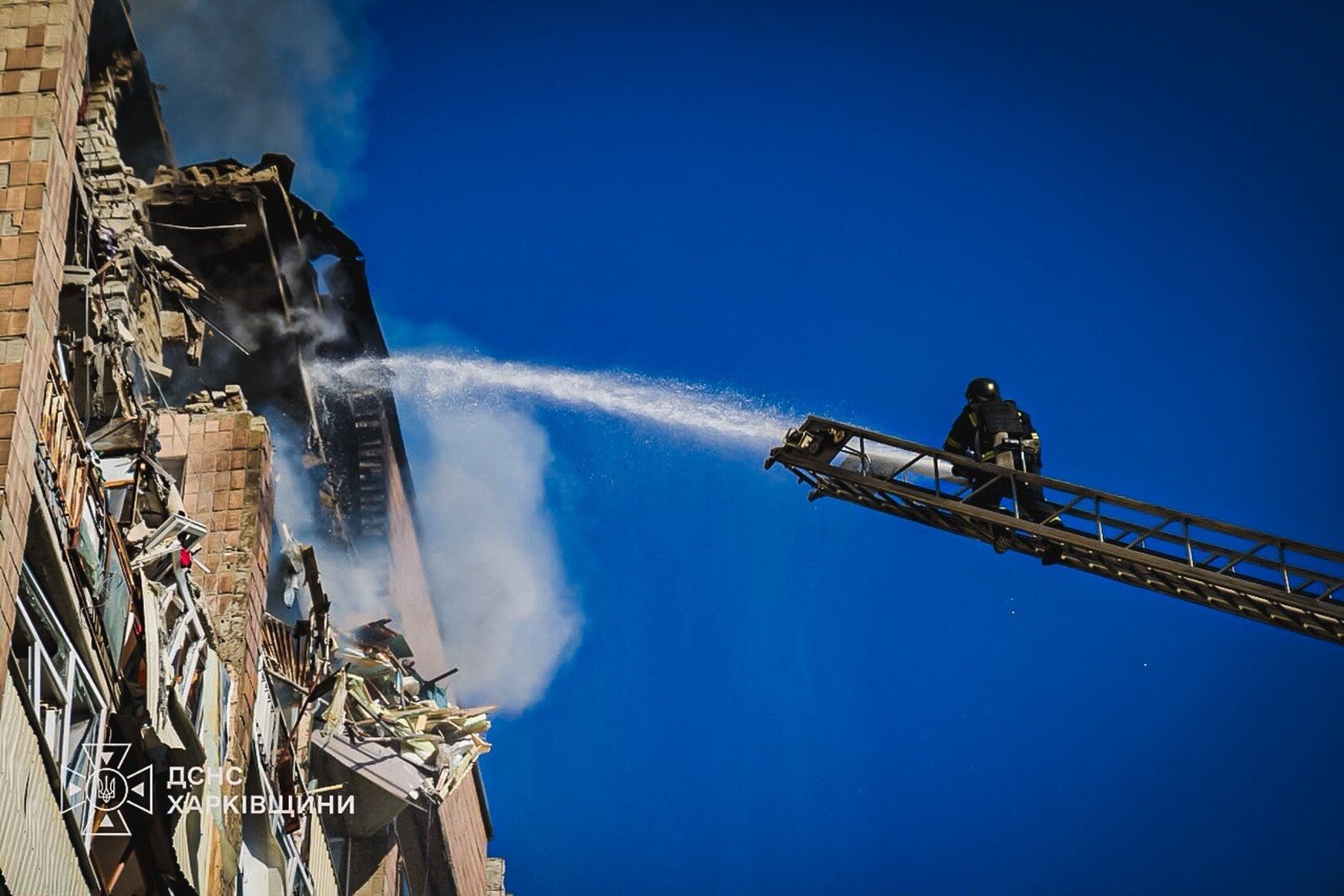
The ceasefire was announced on Sunday. This is Kharkiv on Monday (p3)
The World
Both parties have agreed, said one party. Kyiv says it learned from the media
Technology
Forty per cent more tokens per megawatt — than a system nobody will name
The Rabbit Hole
A craft whose largest forum bans the thing its biggest channels sell
Twelve Desks · One WorldSource: State Emergency Service of Ukraine, Kharkiv region, via The Kyiv Independent. A firefighter works on a Kharkiv apartment block struck on 12 October 2026, the day after the announced energy ceasefire. Cropped; no other alteration.
assembled in 1h10m · ~142.2M tokens (1.2M in · 140.4M cached · 547k out) · ≈US$92 at API list prices (opus-5)
● Meridian · ContentsNo. 131 · 13 October 2026 · Tuesday
This Issue · No. 131
Contents
p3 The World — both parties have agreed, said one
p4 The World — almost certainly, highly likely, and bailed
p5 Singapore — the clinics opened; the masks did not
p6 The Atelier — England still cuts it; Italy owns it
p7 Technology — forty per cent more than what?
p8 Technology — two point two times, or a third slower
p9 The Kit — priced in four currencies, none of them ours
p10 The Good Life — limited worldwide, sold in one country
p11 Screen & Sound — two thousand screens, one logged review
p12–13 The Family Desk — threefold became sixty-five per cent; a framework, not a cohort
p14 The Macro Desk — a hawkish speech into a closed bond market
p15–17 The Rabbit Hole — close-up card magic, and the rule against secrets
p18 Fitness — the trick that did nothing, measured
p19–20 The Diary — eight of fifteen carry no price; the brand opened its own house
p21–23 The Long Read — p-hailing, and a floor the platform helps pay for
THE SPINE: the say-so — the claim that rests on who made it, printed where a measurement belonged
Sagan’s rule is usually read as a weapon against cranks. It is better read as a unit of account. This issue is full of claims pitched exactly one notch above what stands behind them — a ceasefire with one signatory, an attribution with no explosives, a ratio with no denominator, a worldwide edition on sale in one country. The spine is the say-so, and the discipline is to ask who is holding it up.
The Strip · at Monday’s close
US 2-year2
4.80%
▲ 5bp
US 10-year2
5.24%
▲ 2bp
VWRA
$193.72
▲ 0.11%
Global agg
$5.74
▲ 0.09%
DXY
102.58
▲ 0.36%
USD/SGD
1.2799
▼ 0.04%
Brent
$105.92
▲ 1.15%
Gold, spot
$4,169.99
▼ 0.59%
Bitcoin
$82,770
▼ 0.80%
Treasury yields are Friday’s par yields — the cash market was shut on Monday for the holiday. The Straits Times Index closed 5,415.48, up 0.25% (p14). Not advice.2
From the Archive · No. 125, 7 October 2026
Six days ago this desk ran the same shape through an optical bench. The Atelier of No. 125 set two arcseconds of porro-prism alignment against ten arcminutes — the gap between what a maker measures and what a badge asserts.3
The pattern recurs because it is cheap. A number with no reference class costs nothing to print and cannot be checked. Today it is forty per cent against an unnamed baseline (p7) and ninety-six per cent retention against a different harness (p8).
The counter-move is always the same. Ask what the comparison is to, and whether the person making it chose it. Four of this issue’s fifteen desks turn on that question, and the Long Read turns on who is sitting across the table (p21).
SOURCES 1 Carl Sagan, Cosmos: A Personal Voyage, episode twelve, “Encyclopaedia Galactica”, first broadcast 1980; the formulation is Sagan’s rendering of a principle stated earlier by Laplace and by Marcello Truzzi. 2 Levels as set out on the Macro Desk and sourced there: Treasury par yields for 9 October 2026 from the Treasury’s own daily series, the cash market having been shut on Monday 12 October for the federal holiday; all other levels at Monday’s close from commercial market-data services, read at source. 3 This magazine’s own No. 125 of 7 October 2026, read in the archive.
● Meridian · The WorldThe Meridian Dispatch
The World · The Energy Ceasefire
Both parties have agreed
Kyiv says it learned from the media. The Kremlin would say only that contacts continue. Six Ukrainian energy sites were hit inside a day.
The post went up on Sunday. “Effective immediately, there is an ENERGY CEASEFIRE in the War between Russia and Ukraine… Both parties have agreed. Do not break it!” Within hours a Russian strike reached the CHP-5 thermal plant at Kharkiv. The platform it was posted on refused this desk outright, so that is the wording as two newsrooms carried it, identically, rather than read at source.1
By Monday Kyiv had answered twice. First: “We didn’t know about it. We learned from the media.” Then, to the Warsaw Security Forum: “we do support it, but I have not heard approval of this proposal from the Russian side, and this looks strange.” Asked what Moscow had agreed to, the Kremlin spokesman offered that “contacts are ongoing” and nothing else.2
The first twenty-four hours of the ceasefire are a matter of record. At least ten killed and sixty-nine injured across Ukraine — five dead and forty-two hurt in Kharkiv alone, on the governor’s count. Six energy facilities struck, plus a state gas-production site. 121 Shahed-type drones launched, 76 of them jet-powered, 89 downed or suppressed, impacts at fifteen locations. One oddity of the reading: the outlet’s headline said sixty-nine injured and its own URL still said seventy-three.2
“Putin does not read TruthSocial.”
A price is attached, and it is not a Russian one. On Monday a Kyiv newsroom reported, on three officials who would not be named, that Washington had threatened to cut intelligence sharing and the NATO-financed weapons list known as PURL — $6.7bn in its first year — if Ukraine struck Russian refineries during the truce. “They called all the top military officials with threats.” The outlet later removed a paragraph after a deputy head of the presidential office denied having confirmed it to another paper. No American official has answered on the record. Single-sourced, and printed as such.3
The Chatter · the traders doing the arithmetic
Giovanni Staunovo of UBS: “Only time will tell how durable it proves to be” — comparable commitments “ultimately failed to hold”, and the Russian volumes “would only partially offset the decline in seaborne diesel exports.”James Bambino and Richard Joswick of S&P Global Commodity Insights: “We see the immediate market impact as limited.”Patrick De Haan of GasBuddy, on the tonnage released immediately: “I don’t believe this changes much.”45
The Sceptic · The Diesel May Not Exist
The deal promises Russian diesel — 300,000t now, 500,000t in November, 1m tonnes thereafter — under a licence running to 7 April 2027. Tanker-tracking data has Russian diesel exports falling from 706,000 b/d in January to 47,000 b/d in August, with about half of Russian refining capacity offline. Bob McNally of Rapidan Energy: the incremental export is 0.1–0.2m b/d against a world shortfall nearer 1m, so it “will help on the margin but will fall well short of the losses.” Gulf Oil’s Tom Kloza puts it plainly: “Would Russia be willing to part with diesel to the U.S. when it doesn’t have enough to handle domestic needs?”145
1.5 days
What the immediate 300,000-tonne release is worth against normal American consumption5
A ceasefire is an agreement or it is a press release. This one has one signatory, one licence, a tonnage schedule, and a party that has not said yes.
SOURCES 1 The Office of Foreign Assets Control’s own recent-actions entry of 9 October 2026 for Russia-related General Licence 135, “Authorizing Transactions Related to the Sale, Delivery, Offloading, and Importation of Diesel Fuel of Russian Federation Origin”, read at source for the title and the instrument itself; the 7 April 2027 run-off and the tonnage schedule are at note 4. 2 The Kyiv Independent, 11–12 October 2026, read at source across four items: the casualty and drone counts attributed to Governor Oleh Syniehubov of Kharkiv Oblast and to the national air force; both Zelensky passages, including the single-refinery remark, the “we learned from the media” line, the Warsaw remarks and the weekly tally; the Kremlin spokesman’s “contacts are ongoing”; and the “Putin does not read TruthSocial” line. The sixty-nine against seventy-three discrepancy is between that outlet’s own headline and its own URL slug as this desk read them. 3 The same outlet’s report of 12 October 2026 on the intelligence-sharing and PURL threat, resting on three unnamed Ukrainian officials, read at source including the later removal of one paragraph after a public denial by a deputy head of the Office of the President. Treated as single-sourced. 4 The National (Abu Dhabi), 12 October 2026, read at source for the UBS and S&P Global quotations, the tanker-tracking export series, the share-of-shortfall estimate, the tonnage schedule and the licence run-off date. 5 Newsweek, 12 October 2026, read at source for Patrick De Haan, Bob McNally and Tom Kloza, and for the day-and-a-half comparison against American supply. Trump’s post could not be read at source: truthsocial.com returned HTTP 403 to this desk, and the text is as carried identically by NBC News and France 24 on 11 October 2026.
● Meridian · The WorldAround the Desks
Zelensky addresses the Warsaw Security Forum by video link on 12 October, the speech in which he said he had not heard Russian approval of the truce and that it “looks strange”. Source: Omar Marques / Getty Images, via Al Jazeera. Specific subject.
Around the Desks · Attribution Without Charges
Almost certainly, highly likely, and bailed
Thirty-two foreign ministers co-signed Britain’s attribution of the Fairford plot to Iran. No explosives were recovered, and the five men first arrested were released.
To the Commons on Monday, the Prime Minister said the incident at RAF Fairford on 27 September was “almost certainly directed by Iran’s Islamic Revolutionary Guard” and “highly likely to have been coordinated in Iran”. The Home Secretary narrowed it by a notch the same afternoon: “highly likely to have been coordinated by a known individual based in Iran.”1
Two names were sanctioned. Ruhollah Bazghandi, who heads IRGC counterespionage operations, and Shahram Ali Reza Tamarzadeh Jakki, described as a facilitator of the Zindashti criminal network — asset freeze, travel ban and director disqualification apiece. Iran’s ambassador was summoned and “categorically rejected” any role, urging Britain to avoid “unsubstantiated statements”. The United Kingdom now lists more than 550 Iranian individuals and entities.1
Then the unusual part: thirty-two foreign ministers put their names to a single paragraph — “We recognise the United Kingdom’s attribution of Iran’s involvement in the incident at RAF Fairford on 27 September” — Washington, Wellington and Budapest among them. What thirty-two governments have co-signed is not a finding of fact. It is a judgement of likelihood.2
Five men were arrested before dawn. Three vans held petrol. No explosives were found, and everyone went home on bail.
Five British men in their twenties were arrested before dawn on 27 September on suspected terrorism and explosives offences. Petrol was found in three linked vans. No explosives were recovered. All five went out on police bail; a 22-year-old Briton and a 25-year-old British-Iranian were arrested later. One outlet covering the attribution calls the plot “largely unexplained”. The Home Secretary’s own figures size the gap: more than 23 charged under the National Security Act since 2023, five convictions. The falsification test is simple — charges that never mention Iran.14
Beijing — Global Times
Reads the diesel carve-out as proof the rule-writer exempts itself, and addresses the lesson to Washington’s allies rather than to Moscow: “Washington made the rules. Now, Washington is making the exceptions.” · “Never hand the lifeline of your energy supply to someone else — even if they call you an ‘ally’.”5
Moscow — TASS
Does not cover the ceasefire at all. Covers the diesel as market management: the deputy prime minister says the supplies “will allow us to increase volumes and partially balance supply and demand” and that world diesel markets have already “adjusted downward by about 5-6%”.6
Still Running
Hormuz — the answer came back “insufficient”. Iran’s Supreme National Security Council secretary said on Sunday that the American reply to Tehran’s seven conditions for reopening the strait was insufficient, and that Iran is “no longer in the process of responding to the Americans”. The offer, answered through Qatari intermediaries, had promised passage within seven days.7
Four documents in one afternoon, and not one of them is a verdict.3
SOURCES 1 Three statements published on the British government’s own site and read in full there, all of 12 October 2026: the Prime Minister’s statement to the House of Commons, for the “almost certainly directed” and “coordinated in Iran” formulations; the Foreign Secretary’s statement on Iran, for both sanctioned names and their described roles, the three measures, the summoning of Iran’s ambassador and the cumulative total of more than 550 Iranian individuals and entities; and the Home Secretary’s oral statement on national security, for the narrowed “known individual based in Iran” formulation and for the figures of more than 23 charged under the National Security Act since 2023 and five convictions. 2 The joint statement on Iran of 12 October 2026, read at source on the same site for the quoted paragraph and for the full list of thirty-two signatory foreign ministers. 3 The European External Action Service’s own release of 12 October 2026, read at source for the 1,569 listings and the 826 and 743 split, the separate decision listing 77 individuals over the State Duma vote, the quotation from the High Representative, and the instruments — Council Decision (CFSP) 2026/2279 and Council Implementing Regulation (EU) 2026/2281. The Council’s own site refused this desk; the Service carries the same text. The “almost 1,600” figure is the wire rendering, against the Council’s 1,569. 4 Al Jazeera, 12 October 2026, read at source for the arrests, the petrol in three vans, the absence of recovered explosives, the police bail, the two later arrests, the Iranian embassy’s response and the “largely unexplained” characterisation. 5 Global Times editorial, 12 October 2026, read at source. 6 TASS, 12 October 2026, read at source. 7 Reuters copy of 12 October 2026 as carried by Haaretz and read there, for the “insufficient” characterisation, the seven conditions and the seven-day passage offer; the Sohar drone strike is from a wire live file of 12 October citing United Kingdom Maritime Trade Operations. The National’s own 11 October Hormuz piece returned a 404 to this desk. 8 Al Jazeera and PBS NewsHour, 11–12 October 2026, read at source for the nationality breakdown, the Terminal 4 figures attributed to the General Authority of Civil Aviation, the airport closures, the Jeddah disruption counts attributed to a flight-tracking service, and the Djibouti toll. 9 Agence France-Presse as carried by Al Jazeera, 12 October 2026, read at source. Single-sourced and witness-based; printed as such.
● Meridian · SingaporeThe Little Red Dot
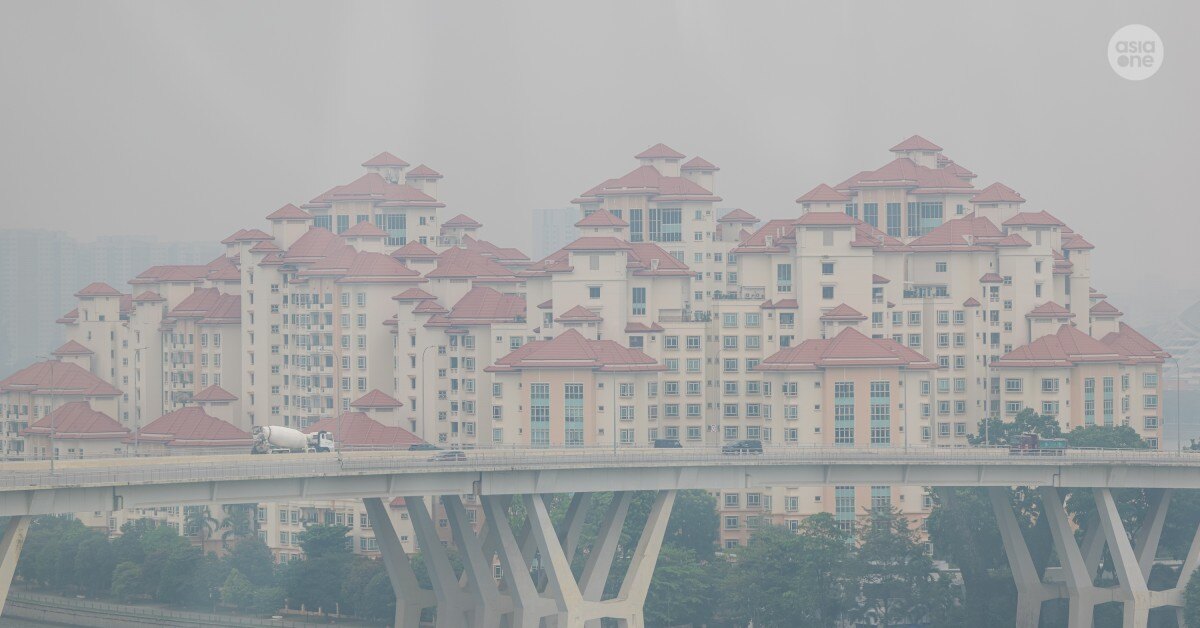
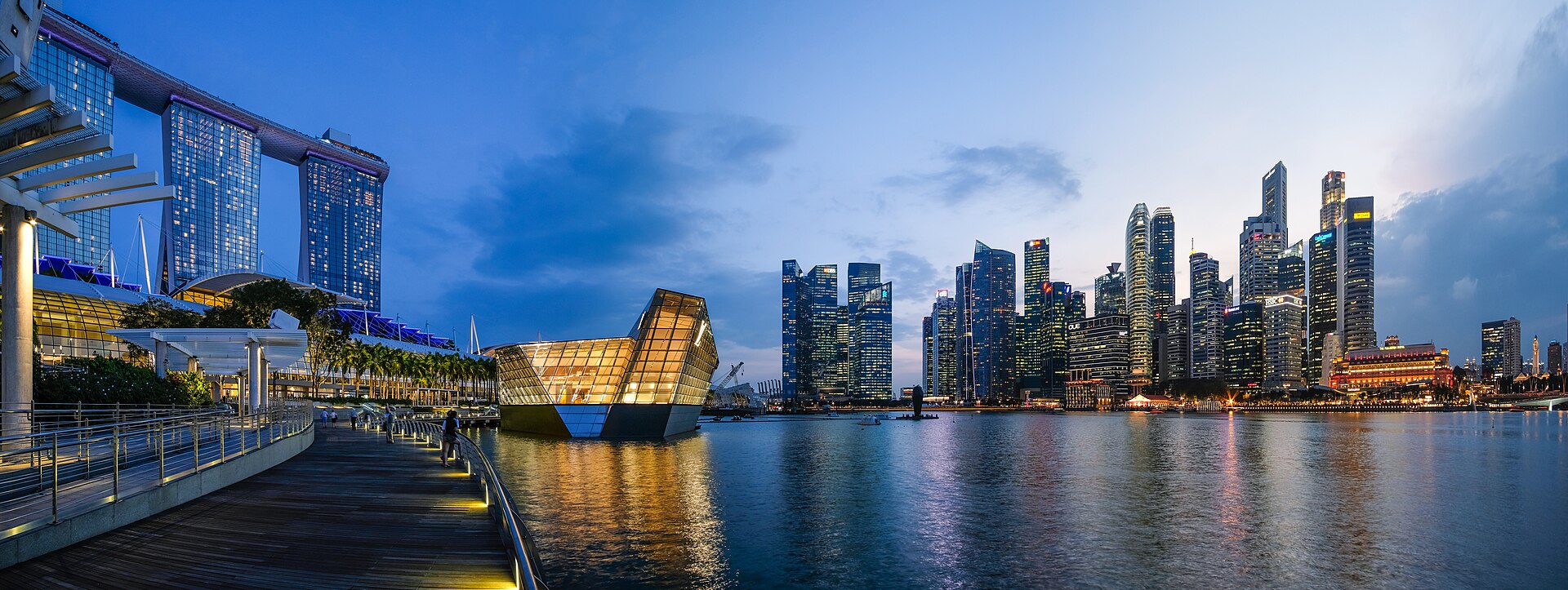
Central Singapore on 12 October, the day the haze subsidy scheme opened. One-hour PM2.5 reached 156 micrograms per cubic metre; the ladder that releases N95 masks begins at a 24-hour index of 200. Source: AsiaOne, photograph by Shafiq Apandi, 12 October 2026. Specific subject.
Singapore · The Subsidy Below The Line
The clinics opened; the masks did not
Haze consultations are capped at ten dollars from Monday. The index that releases N95s has still never been reached, five weeks in.
From 12 October the health ministry switched on both the Public Health Preparedness Clinic scheme and the Haze Subsidy Scheme. A haze consultation is now capped at no more than $10 for eligible citizens, no more than $5 for Pioneer and Merdeka Generation seniors, and is fully subsidised for Public Assistance cardholders, at participating general practices and at every polyclinic. Seven conditions are covered by name: allergic rhinitis, asthma, bronchitis, conjunctivitis, chronic obstructive pulmonary disease, upper respiratory tract infection, and their complications.1
The two eligibility lists do not match, and the mismatch is worth reading twice. At a participating general practice the cap reaches citizens aged 18 and below or 65 and above, or those on Public Assistance, the two generation schemes, CHAS Blue and Orange only, or holding a Medical Fee Exemption Card. At a polyclinic it reaches all citizens. A forty-five-year-old asthmatic with a Green card is covered in one building and not the other.1
On the day it opened the air was bad and not bad enough. The 24-hour index ran 104 in the north to 147 central and west; one-hour PM2.5 reached 156µg/m³ centrally at 1pm, inside the “high” band; by evening the regional readings were 118, 122, 139 and 155. The response ladder published on 9 October starts at a 24-hour reading of 200. The index first crossed 101 on 4 September, peaked at 192 last Friday, and has never reached the rung where the respirators come out — of which the environment minister said on Saturday, “We have sufficient stock of the N95 mask, and will be prepared to deploy when necessary.”23
The Chatter · the forum concedes the point
The liveliest local thread this desk could reach was a HardwareZone argument about a visiting tourist complaining that Singapore’s air was worse than New Delhi’s — 33 replies, opened late on Sunday. The register is mocking; the verdict is not. zoossh: “This might be the only time it is true.”mirukuboi: “He’s not wrong.”Goodshot redirects it: “Tell them go ask Indonesia, its not our fault anyway.” Singapore’s own parenting and local forums carried nothing live on the air at all.4
The Sceptic · Jakarta’s Answer, On The Record
The head of Indonesia’s government communications agency said on 10 October that the haze is a natural phenomenon “outside human error”, that Indonesia had supplied oxygen to both neighbours, and asked Malaysia and Singapore to “understand the situation”. This desk read that in a citation rather than in the Indonesian daily itself, and says so. The domestic sceptic needs no quotation: a ladder is a plan until somebody climbs it, and five weeks of unhealthy air have produced a subsidy, a stock count and no distribution.5
156
Micrograms per cubic metre, one-hour PM2.5, central region, 1pm Monday — the “high” band3
Also On The Desk
The war’s domestic measure is the pump board. One retailer added 3 cents across petrol grades on Monday afternoon, leaving diesel alone — the second rise in a fortnight after 5 cents on 29 September. Its 95-octane is $3.54 a litre, up 17 cents, about 5.0%, since 6 September. The monetary statement lands Wednesday (p14).7
A ladder is only a ladder once somebody is standing on it.6
SOURCES 1 The Ministry of Health’s own release of 11 October 2026, “Haze Subsidy Scheme to start at Public Health Preparedness Clinics and polyclinics from 12 October 2026”, read in full at source for all three fee tiers, the seven named conditions and both eligibility lists. The release quotes no official and gives no clinic count; a claim circulating that this is the scheme’s first activation since 2015, and a figure of 1,370 participating clinics, appear only in one small outlet and are therefore not printed. 2 The National Environment Agency’s release of 9 October 2026, “Singapore Ready To Step Up Haze Response”, read at source for the 200 and 300 thresholds and the measures attached to each, and for that date’s 7pm readings. 3 The regional index and PM2.5 readings of 12 October 2026 and the respirator issue by the four public-transport operators, as reported that day by a Singapore news service and read at source; the national haze portal’s own 5:35pm situation update of the same date, read at source, records moderate to dense smoke haze over parts of Singapore. The environment minister’s remarks are from her ministry’s own published soundbite of 10 October 2026, read at source. The Johor school closure and its extension to 16 October come from a regional broadcaster’s report; that broadcaster refused this desk directly, so the citation was read instead. 4 The HardwareZone thread of 11–12 October 2026, read at source, including the reply count and each quoted username. Reddit was reachable to this desk’s researchers but carried no live Singapore thread on the haze. 5 The Indonesian official’s remarks of 10 October 2026, read in the citation accompanying an encyclopaedia entry on this year’s haze rather than in the originating Indonesian daily, which this desk did not reach. Flagged as such. 6 The trade ministry’s own newsroom release on the second Singapore–Brunei Joint Committee Ministerial Meeting, 12 October 2026, read at source for the date and the co-chairs; the goods list and the S$2.32bn figure sit in a linked document that did not render and are second-sourced to a Singapore news service of the same date. The ministry’s own naming and the redirect were observed directly. 7 A Singapore money desk’s pump-price round-up of 12 October 2026, read at source. Single-sourced: no company or official statement is attached, and the published table’s 92-octane column is misaligned against its own body text, so only the 95-octane figure is printed. The central bank’s own advance release calendar, read at source, puts the Monetary Policy Statement on 14 October with no time of day published.
● Meridian · The AtelierBuy It Once
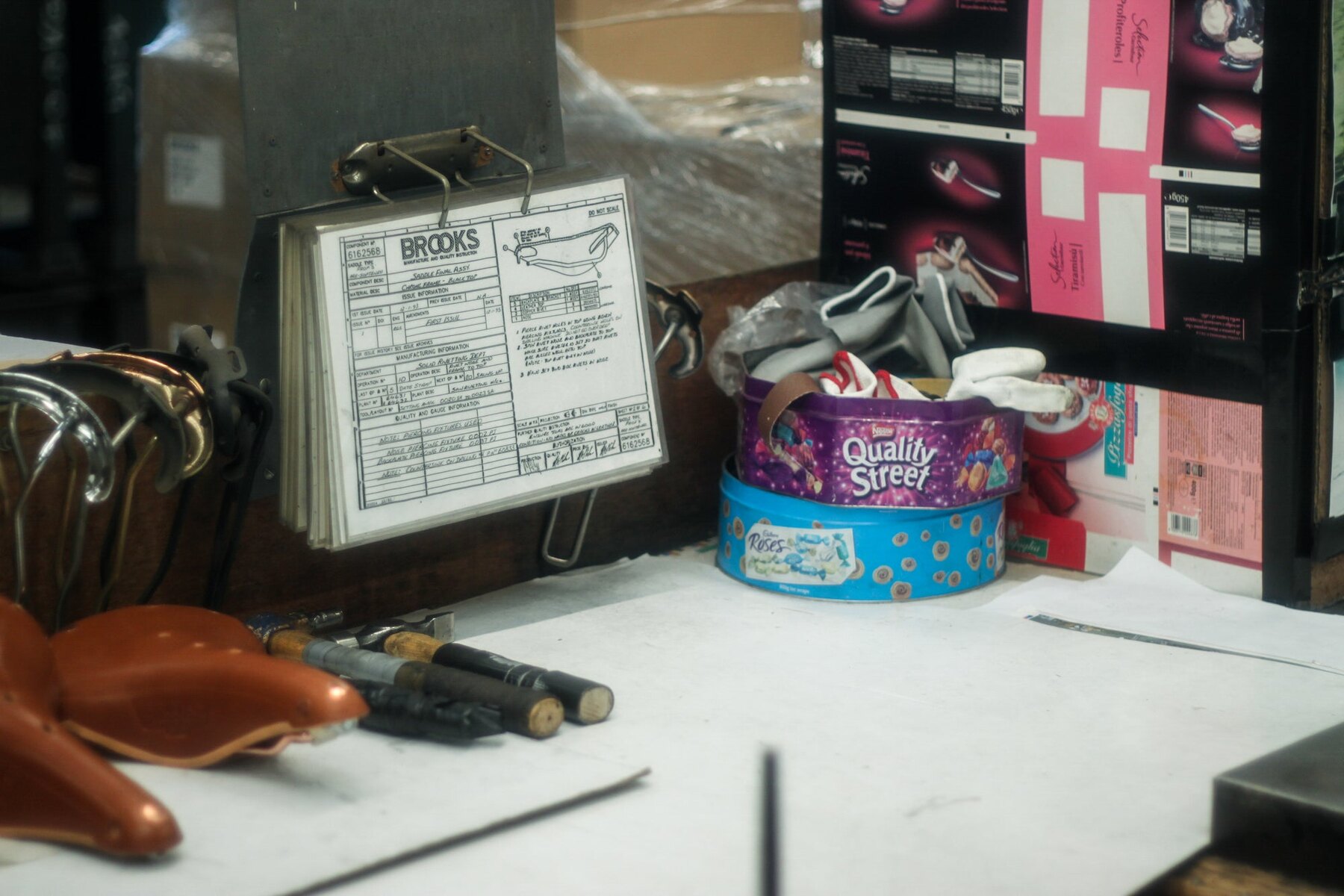
A working bench at Smethwick: leather tops stacked at the left, hand punches and drifts laid out, a job card on a clipboard, and loose components kept in biscuit tins. The leather saddles are still made here; the Cambium is made in Italy. Source: Brooks England, from its own account of the Smethwick factory. Specific subject.
The Atelier · Rivet Against Bolt
England still cuts it; Italy owns it
A tensioned leather saddle is a suspension bridge, not a cushion. One construction choice decides whether you own it for thirty years or until the leather goes.
Begin with the mechanism, because it is unlike every other saddle sold. A tensioned leather top is a suspension bridge: nothing underneath supports the rider, the hide spans nose to cantle plate under tension, and your weight is carried by its tensile strength and its resistance to creep. Too thin and it sags for good; too thick and it never moulds. So thickness governs — and Brooks publishes one for exactly one saddle: the B17 Utmost, “vegetable-tanned, 5.5mm thick”, stainless rails, €300. The revived French Idéale uses about 5mm. That is 12 to 14 ounces in a leatherworker’s units: structural leather, not upholstery.1
Which is the real line here, and it is not price. Brooks stocks a €10 tension pin, a €7 shackle, three nose rivets for €7 — and no replacement leather top anywhere in the catalogue, because the top is riveted on and the company does not repair leather parts. Gilles Berthoud, at Fleurville, bolts its tops on with stainless screws into brass washers set behind the seating area, keeps spare tops in stock, and will swap a solid top for a cut-out one. Rivet against bolt is the whole buy-once argument, decided at the factory before you sit on it.13
The Chatter · what the tropics report
jay clock, on a garaged Brooks: it “builds up a layer of green mould”, and “A wipe with a cloth sorts it.”rogerzilla supplies the uncomfortable mechanism: “The mould is probably feeding on old Proofide, which I think used to be tallow.” The dressing is the substrate. From Honolulu, Robert F. Harrison: “all of my leather saddles have gotten wet, damp, moist, splashed, sweated on and over, and in the end, they are all fine” — with the condition buried in the same post, that he never parks without a cover.4
The Sceptic · The Hole Does Nothing
Dr Frank Sommer’s Cologne work measured penile oxygen pressure on the same saddle with and without a cut-out: 23.8 against 21.4 mmHg, no statistically significant difference, both around 65% below resting level. What worked was width — “more than 50% better” oxygenation from a wider saddle. A 2011 study of 48 competitive female cyclists found cut-outs produced 4 kPa more mean and 11 kPa more peak perineal pressure. Buy the width, not the hole.5
860g
A sprung Brooks Flyer, against 182g for a carbon race saddle — the maker’s own figure1
The Singapore Reality
Visible premium, and a practice rather than a purchase. Brooks names Rodalink as distributor though its own locator finds nothing here. Shop pages read: B17 Standard S$200, S$219, S$235; Special S$259–265; Cambium C17 All Weather S$179–220. One shop stocks a S$23 rain cover. The manual is the honest guide — “Never tension a wet saddle” — and here that is permanent. Unwilling to run that practice? Take the Cambium, or a correctly sized modern saddle.16
Next On The Bench
Ironing boards & steam generators — boiler pressure, soleplates, and an enormous badge tax.
Thermal lunch jars — the retention claim is the one spec you can test.
Pillows & bolsters — fill, loft and what the tropics do to all three.
The saddle is sold on romance and decided by arithmetic: thickness, width, and whether the top comes off.2
SOURCES 1 Brooks England’s own site, read at source across its leather, Special, Utmost, Cambium, maintenance and spare-parts collections and the product pages behind them: the B17 Utmost’s 5.5mm vegetable-tanned specification, stainless rails and €300 price; the €150 B17, €190 Special, €260 Special Titanium at 410g, €130 Cambium C15 and C17; the 860g Flyer and the 464g C17; the “Made in: England” line on every leather page against “Made in: Italy” on every Cambium page; the €10 tension pin, €7 shackle and €7 rivet pack, and the absence of any replacement leather top in the catalogue; and the company’s own factory account. The leather-saddle instruction manual was read as a document for the moisture and tensioning instructions quoted and for the European-representative line. 2 A contemporaneous trade report of 2 July 2002 on the sale to Selle Royal, read at source for the staff, plant, turnover and acquirer-size figures; the ownership chronology was cross-read against an encyclopaedia entry and a cycling publication’s company history. One outlying source dates the sale to 2012, against three at 2002 including the trade report; 2002 is printed. 3 Brooks’s own ten-year warranty page for the registration window, the production code and the leather-only, non-transferable and second-hand conditions; the tensioning and saturation exclusion is quoted from the manual. Gilles Berthoud’s construction, models, weights and prices are from three dealers’ own pages read at source in the United States, the United Kingdom and Canada; the maker’s own site returned HTTP 503 on every path attempted, repeatedly, so no official Berthoud price, specification or lead time was read at source and none is printed as though it were. 4 A cycling forum’s mould thread of 2019 and an owners’-list thread of 2013, both read at source, for each quotation and username as it appears there. There is no pressure- or thermal-mapping study of leather against rubber tops in heat that this desk could find; the heat question is anecdote on both sides. 5 The Cologne oxygen-pressure comparison and the width finding, and the 2011 journal study of 48 competitive female cyclists with its mean and peak pressure differentials, as reported in cycling-medicine coverage read at source. 6 Three Singapore retailers’ own product pages, read at source on 12 October 2026 for every SGD figure and for the rain cover; Brooks’s own distributor page names the Singapore distributor, whose site returned HTTP 403, so no distributor price was read. Marketplace listings showed lower, volatile third-party prices and are not printed.
● Meridian · TechnologySilicon & Sovereignty
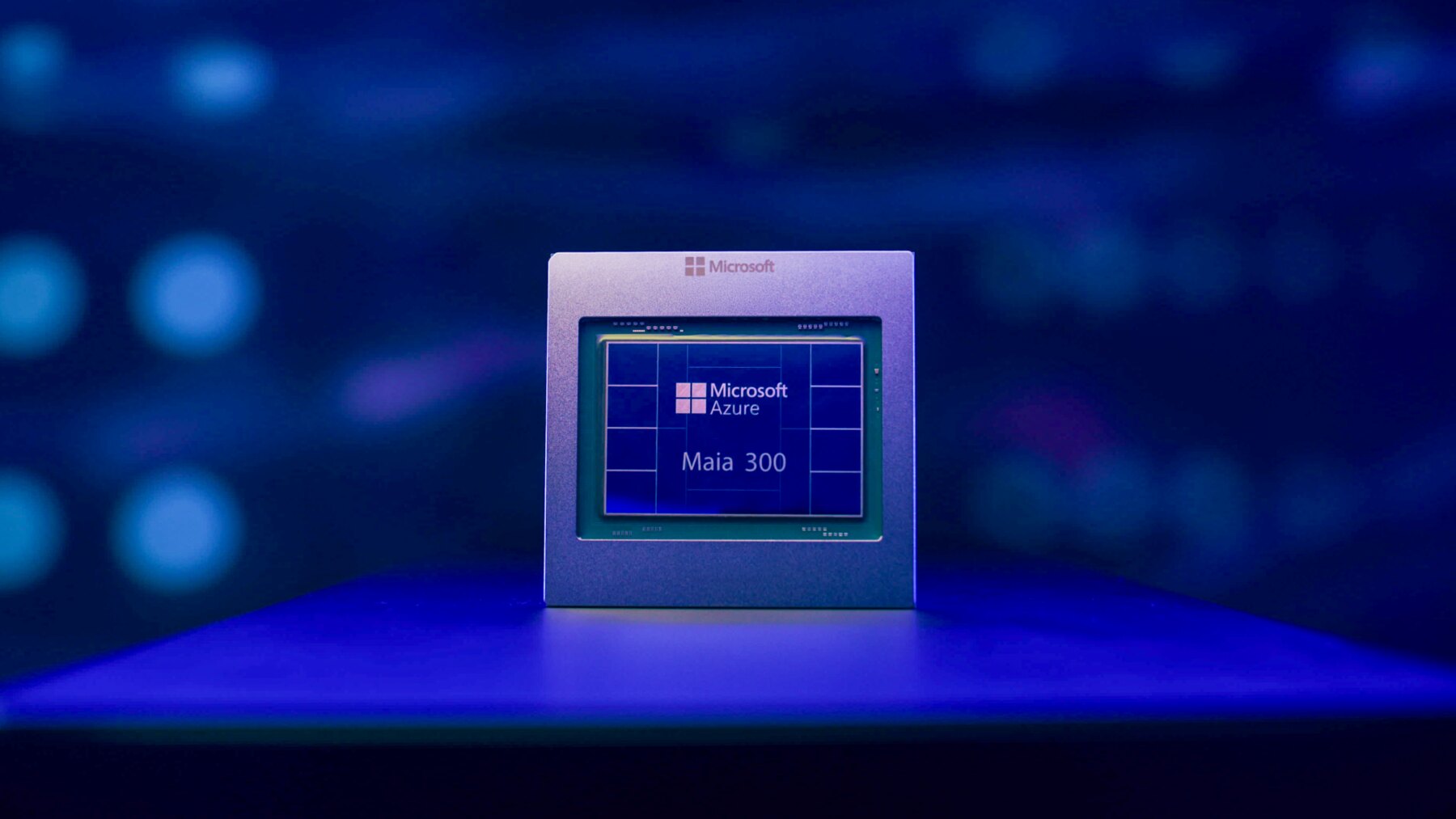
Maia 300, announced on Monday: 288GB of HBM4 per accelerator at 18TB/s inside 950 watts, on TSMC’s N2P. The performance claims are all ratios — 40 per cent more tokens per megawatt than an unnamed GPU system. Source: Microsoft Corporation, hero image attached to its announcement of 12 October 2026. Specific subject.
Technology · The Unnamed Baseline
Forty per cent more than what?
Microsoft’s new accelerator is specified almost entirely in ratios. There is no absolute throughput figure anywhere in the announcement.
Maia 300 was announced on Monday, and the hardware is described precisely: eight HBM4 stacks, 288GB per accelerator, 18TB/s of memory bandwidth inside a 950W envelope, compute chiplets on TSMC’s N2P. 96 accelerators to a rack drawing 167kW, holding 27.6TB of HBM at 1.7PB/s aggregate; superpods reach 12,288 accelerators across 128 racks, any one talking to any other at 750GB/s.1
The performance is described differently. “40% more tokens per megawatt” than “leading GPU-based systems” — which systems is not stated. Up to 7× the rack-scale token throughput and more than 2.5× the performance per watt of Maia 200. 36% more system compute FLOPs. Nowhere in either the announcement or the architecture deep-dive is there an absolute FLOPS number to anchor any of it. Maia 200’s own headline last year was “up to 1.7x more tokens per watt” — also against an unnamed GPU.1
A ratio without a denominator is a sentence with the subject removed.
The week’s other claim came out of Shanghai and moved more money. At an industry event over the weekend the president of China’s CXMT said the company had made progress on a 4F² DRAM cell — more cells per unit of silicon — and would launch a new server memory product before the end of 2026. On Monday the memory complex sold off: Micron $989.04, −3.88%; Samsung Electronics ₩250,500, −4.39%; SK Hynix ADRs −3.6%, Sandisk −5.7%, Seagate −3.4%. CXMT listed in July, rose 466% on debut, and at Monday’s close was China’s largest company by valuation at just under $500bn. Its own English newsroom carries nothing dated October at all.2
The Chatter · the price, not the physics
What the engineers upvote about CXMT is not the cell geometry. The most-discussed item on Hacker News is the discount: “CXMT has been offering DDR4 chips at about half the prevailing market rate” — 265 points, 271 comments. A specialist semiconductor newsletter had framed it as an incumbency problem rather than a technology one: “China’s CXMT Is Set to Challenge DRAM Incumbents”. The 4F² claim is a claim about the price of your next 128GB of RAM (p8).3
The Sceptic · Two Separate Discounts
First, the selloff was already running: Micron entered Monday on its third straight losing session after being up 261% year-to-date through Friday, so attributing the day to Shanghai is partly narrative. Second, and heavier: a Korean daily reported on 30 September court testimony in which a former Samsung employee said CXMT executives code-named Samsung “Yellow Mountain”, sought its 18nm DRAM recipe plan of some 600 steps, and that the company “had no plan to develop the technology independently from the beginning”. Samsung spent ₩1.6tn on that node. A cell announced at a conference is not a wafer.24
466%
CXMT’s rise on its July debut; it now carries China’s largest market capitalisation2
Held Threads, Advanced
TSMC: the beat is confirmed, and it is an exchange rate. September revenue NT$511.86bn, −0.6% on the month and +54.6% on the year — its first down month since July. Third-quarter revenue of NT$1,494.2bn converts at the company’s own assumed NT$32.0 to US$46.70bn, exactly 1.95% above the top of its own guidance, as this desk printed on 10 October. The quarter is restated at actual rates on 15 October, and the beat shrinks with a weaker Taiwan dollar.5
Three announcements, one week, and the load-bearing number missing from each.
SOURCES 1 Microsoft’s own announcement of 12 October 2026 on its corporate blog, and the companion Azure architecture deep-dive, both read in full at source: the HBM4 configuration, the 288GB and 18TB/s per accelerator, the 950W envelope, the N2P process, the 96-accelerator 167kW rack with 27.6TB and 1.7PB/s, the 12,288-accelerator superpod and the 750GB/s any-to-any figure; the “40% more tokens per megawatt” against “leading GPU-based systems”, the “up to 7x” and “more than 2.5x” comparisons against Maia 200, the 36% FLOPs increase, the six switch ASICs in three liquid-cooled trays, the 50V busbar, the greater-than-80% liquid cooling share, the MXFP4 and sub-three-bit formats, the NUMA-for-UMA change, and the 2027 production date. The absence of any absolute FLOPS figure was established by reading both pages end to end. 2 CXMT’s own English newsroom, read at source on 12 October 2026 and carrying nothing dated October; its most recent corporate item, of 20 September, gives the G5 numbers. The Shanghai remarks and the sector moves are from a 12 October financial wire report read at source, which attributes the 4F² detail to a Hong Kong daily citing a company statement; the Micron and Samsung closes, the 466% debut and the valuation were verified independently against a market-data service. 3 The Hacker News item and its score, read at source via the site’s own search index; the newsletter title read at source. 4 Korea JoongAng Daily, 30 September 2026, read at source for the court testimony, the code name, the 600-step recipe plan, the quoted statement and the ₩1.6tn development cost. 5 TSMC’s own revenue release of 8 October 2026, its monthly revenue table, its second-quarter guidance page carrying the US$44.6–45.8bn range and the NT$32.0 assumption, and its financial calendar, all read at source. 6 CNBC, 8 October 2026, read at source for the preliminary guidance range and the comparison; the midpoint caveat follows from Samsung’s own disclosure practice. 7 A Reuters wire report of 9 October 2026 as carried and read at source, for the deliberation and the three questions; Arm Holdings’ Form 20-F for the financial year ended 31 March 2026, read at source on the Commission’s own system, for revenue of $4,920m and operating income of $900m. Arm’s newsroom was read on 12 October.
● Meridian · TechnologyThe Home Lab
The Home Lab · The Author’s Own Table
Two point two times, or a third slower
A merged cache for host-resident experts. The author measured a speed-up on one GPU; the tester who unblocked two measured a loss.
Pull request #29887 — “llama : add a GPU cache for MoE experts kept in host memory” — was opened on 3 October by am17an and merged on the 7th. The mechanism is clean: for expert matrix multiplications whose weights live in host memory, the GPU computes from an LRU cache in video memory and uploads only the misses. It applies to batches of 32 tokens or fewer; anything larger falls back to the old path. You turn it on with --moe-cache-mib, and the author reports that roughly 10% of total expert size is enough. Multiple devices are refused outright in this version.1
The author’s own table is the headline. On a 93.7GiB model with 65.4GiB of experts, an EPYC 7742 and PCIe 4.0 at full width, decoding 512 tokens: an RTX 4090 goes from 25.0 to 39.4 tokens a second, a 1.57× gain at a 72% hit rate; an RTX 5090 goes from 30.8 to 67.8, a 2.20× gain at 89%. Those are real measurements on real hardware, published openly, and they are what the release note will carry.1
The speed-up is a function of bus generation and device count. Neither appears in the number.
Red where the cache wins, slate where it loses. The two right-hand pairs are not in the pull request’s own table. A Meridian original; every figure from the thread, as cited.1
The positive independent reads are real and specific. LeoBorcherding, on an AMD R9700 with 32GB under Windows, went 11.0 to 27.6 tokens a second — 2.5× — at a 94.6% decode hit rate and no prompt penalty. pereirajair, on a 16GB RTX 5060 Ti, 14.95 to 19.26 with prompt speed flat. And miltos22, who got a good result at 50% cached, volunteered the caveat himself: the routing in his test “was highly repetitive, so the result may not generalize”.1
The Sceptic · The Guard Is The Admission
The author blocked multi-GPU in the initial version, and the one person who unblocked it measured a double-digit regression. That is not a bug report; it is the feature telling you what it is. One more reader, insunaa on a 5090, reported the model emitting repetitive filler in reasoning only with the cache on, fixed by moving top-k from 20 to 2048 — a correctness smell, not a throughput one. The shape is identical to PR 30112 in this desk’s last issue: one number up, one number down, and only the first in the title.1
3.6 t/s
A 2-bit model with a cache too small to hold one token’s experts, against 15.1 with no cache1
Also Merged, Also Asymmetric
And the memory shock is the real constraint. Microsoft put a Grace-Blackwell superchip and up to 128GB of unified memory in a 15-inch laptop at $2,599.99 — its own page noting that GPU-addressable memory is less than the total, and giving no NPU figure, no ship date and no per-option memory price. Behind it: contract DRAM up some 60% in the second quarter, 13–18% projected for the third, 10–15% guided for the fourth. Mistral Large 4’s weights, promised “by the end of the month”, are still not out.4
The cache is a good patch. The claim on the front of it is a claim about one bus.23
SOURCES 1 Pull request #29887 in the llama.cpp repository, read in full at source: the title, the author, the 3 October opening and 7 October merge, the mechanism and the 32-token batch limit, the --moe-cache-mib flag and the ten-per-cent sizing guidance, the explicit rejection of multiple devices, the author’s own benchmark table (model and expert sizes, host CPU, bus width, 512-token decode, both GPUs, both hit rates and both speed-ups), and every commenter benchmark quoted here with its hardware — the two-GPU regression and its 16.12-to-10.70 figures, the PCIe 3.0 results at each cache size including the 58.5 baseline, the 2-bit collapse to 3.6 against 15.1, the routing simulation’s hit rates and upload counts, the AMD and Nvidia positive results, and the repetitive-output report with its top-k fix. Usernames are as they appear in the thread. 2 The six model cards and their collection page on the public model hub, read at source for licence, parameter counts and scores, with the index named as the vendor’s own; llama.cpp pull request #30383 and issue #30402, both read at source, for the merge, the endpoint and the batching defect. 3 The quantised model’s own card, read at source for the file sizes, the licence, the retention claim and every benchmark row quoted, including the AIME and tool-calling figures and the card’s own statement that the comparators come from a different harness and that the sample is 120 tasks; the download and like counts were read on the hub the same day. 4 Microsoft’s own product page for the machine, read at source for the price, the memory ceiling, the addressable-memory caveat and the absence of an NPU figure, a ship date and per-option pricing; a configuration price and ship date circulating in coverage appear nowhere on that page and are not printed. The DRAM contract-price figures are from a market-research house and a chipmaker’s own October call as carried by trade coverage; the single-box price comparison is from specialist round-ups and is indicative, not a quote. Mistral’s own post of 6 October was re-read on 12 October with the weights still unpublished.
● Meridian · The KitGear We’re Watching
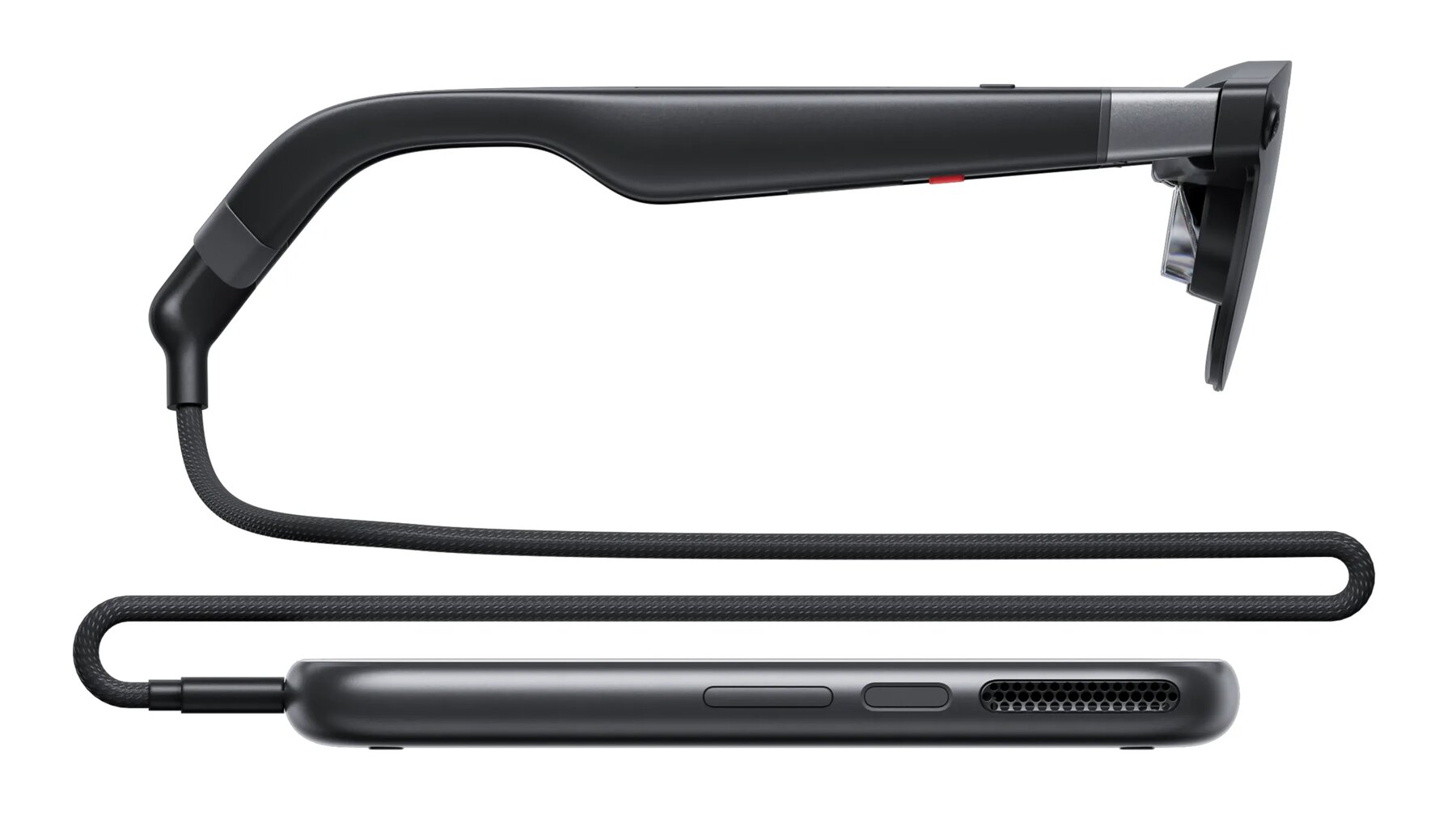
XREAL AURA: 95-gram glasses and the tethered compute puck that drives them, from US$1,279. The maker publishes prices in four currencies; Singapore dollars are not one of them, and its Singapore page returns a 404. Source: XREAL, from the maker’s own AURA product page. Specific subject.
The Kit · Four Currencies
Priced at last, and not here
XREAL’s Android XR glasses finally have a number in four currencies. Singapore dollars are not one of them, and the maker’s own page disagrees with itself about where it ships.
On 7 October XREAL put a price on AURA: US$1,279 for 12GB and 256GB, US$1,499 for 16GB and 512GB — glasses plus a tethered compute puck. The specification is genuinely serious. The glasses weigh 95g and carry Sony micro-OLED panels at 1920×1200 an eye to 120Hz, a 70° see-through field of view, 1,050 nits, 32 pixels per degree, five-step electrochromic dimming blocking up to 99.9% of outside light, and a coprocessor claiming 3ms motion-to-photon. The puck runs a Snapdragon part rated 48 TOPS on a 34.84Wh battery, with Android XR, Google Play and Gemini.1
Then read the same page twice. The banner says sales start in the United States, Canada, Japan and South Korea. The questions-and-answers section further down lists the launch regions as the United States, the United Kingdom, Japan, South Korea and many EU countries — and omits Canada. The page insists this is “not a pre-order, it is an early reservation”, which is not how the press release reads. And the hero image is filed under a name asserting 91g while the specification table says 95; the press release splits the difference with “under 95 grams”. Three statements of weight, one object.12
Two smaller items, same shape. Google began rolling out firmware 6.144 for its earbuds on 6 October, adding a dynamic noise-cancellation mode that holds the seal while you run or chew, press-and-hold live translation across seventy-odd languages, and an auto-pause when a paired watch enters bedtime mode. Google has published no changelog, and two outlets disagree on which earbuds get it — one says two models, the other three. And Apple’s entire official disclosure about a product launch dated today is four words posted by its marketing chief: “Welcome home. October 13.” This desk checked Apple’s own events page, which lists no such event at all; its most recent dated entry is June’s developer conference. The leaked details — a home hub, an A18, a November ship date — come from one well-sourced newsletter, and a hi-fi editor who has read the same material declines even to use the product’s reported name, writing that everything “should be read as well-sourced expectation rather than confirmed specification”.34
The Chatter · the only hands-on there is
No review units, no measured numbers: the only first-hand account of AURA is a few minutes at a chipmaker’s summit — a reviewer viewing a three-dimensional brain scan, a tabletop castle game and windows spread across a room. No nausea; “depth perception took some adjusting”; no score and no verdict, because she says she needs more time with it. That is the entire independent evidence base, and this desk will not dress it as a review. Owner forums were no help: XREAL’s community domain does not resolve.5
The Sceptic · The Catch Is The Queue
An Android title read the launch terms rather than the specification and found the catch: only people who had already paid a reservation before 7 October can order this year, general orders come “in the coming weeks”, and the United Kingdom has been cut from launch despite appearing in XREAL’s own autumn plan announced earlier in the year. It also notes what the spec table does not contain: XREAL still publishes no battery life. A set of glasses with a published pixel density, a published nit figure and a published latency, and no published runtime.6
404
What the maker’s Singapore page returns, four days after the price existed in four currencies1
A price is not availability. Four currencies, and the nearest one is nine hours away.
SOURCES 1 XREAL’s own AURA product page, read in full at source on 12 October 2026: the full specification table including the 95g weight, the panel resolution and refresh, the field of view, brightness, pixel density, the five-step electrochromic dimming and its 99.9% figure, the coprocessor latency claim, and the puck’s processor rating, battery and software; the two mutually inconsistent launch-region lists, one in the page banner and one in its questions-and-answers section; the “not a pre-order, it is an early reservation” wording; the hero image filename asserting 91g; the Singapore path returning HTTP 404; and the retail locator listing United States locations only. 2 XREAL’s own press release of 7 October 2026, read at source for both United States prices, the Canadian, Japanese and Korean price ladder, the “under 95 grams” wording, the co-development claim and the statement that further markets follow in 2027. 3 Two trade reports of 7 October 2026, read at source, for the firmware version and its date and for the four added features; the two disagree on which earbud models receive the update — one naming two, the other three, the latter stating explicitly that its details come from early reports rather than a full changelog. Google has published no release notes. 4 A Mac-focused title’s reports of 8 and 11 October 2026, read at source, for the four-word post by Apple’s marketing chief and for the leaked hardware details attributed to one newsletter; Apple’s own events page was read by this desk on 12 October and lists no such event. The hi-fi editor’s cautions are from his piece of 10 October 2026, read at source. 5 A games-and-technology title’s hands-on of 7 October 2026 from a chipmaker’s summit, read at source, including the quoted observation and the reviewer’s own statement that she withholds a verdict. XREAL’s community domain does not resolve; the principal headphone forum answered with a bot challenge, and Reddit was not reachable to the researcher on this cluster. No community sentiment is reported for this product rather than invented. 6 An Android title’s report of 8 October 2026, read at source, for the reservation-holders-only condition, the “in the coming weeks” wording, the United Kingdom’s removal from launch against the earlier announced plan, and the absence of a battery-life figure.
● Meridian · The Good LifeObjects & Escapes
The Oceanus OCW-SG1000MC-1AJR, ¥748,000: DLC-coated titanium and a marble ceramic bezel blended so each of the 300 patterns differs. Limited “worldwide”, and sold only through Casio’s own partner shops in Japan. Source: Casio, as published by Gear Patrol with its hands-on report of 7 October 2026. Specific subject.
The Good Life · Three Hundred Worldwide
Limited worldwide, sold in one country
Casio’s ¥748,000 Oceanus runs to 300 numbered pieces and reaches them through Japanese partner shops only. Its predecessor cost ¥66,000 less in twice the quantity.
Reference OCW-SG1000MC-1AJR, announced on 6 October, released 13 November: ¥748,000, 300 serial-numbered pieces. Titanium case and solid titanium bracelet, both coated; 47.5 × 43 × 11.7mm and 100g; a marble ceramic bezel made by blending black and white ceramic so that each of the three hundred patterns differs, with blue-green where the colours meet, faceted 24 times. Glossy black ceramic dial, a cutout over a skeletonised date wheel, sapphire anti-reflective on both faces, 10 bar.1
The movement is the part a collector should read twice, because it is unchanged: a solar quartz calibre with six-band reception and Bluetooth sync — roughly 300 cities of world time against 27 on the watch alone — keeping ±15 seconds a month untethered. One reviewer puts it plainly: the calibre “doesn’t change anything under the hood”. What the price buys is the bezel.12
Now the limitation, which this desk has been reading closely for three issues. The run is described as 300 worldwide — and it is listed only on Casio’s Japanese site and sold only through the company’s own Watch Partner Shops in Japan. A worldwide limit with a one-country channel is not a lie, but it is not what a buyer in Singapore hears. Set it against the previous partner-shop Manta, which carried a cut-glass sapphire bezel at ¥682,000 in 600 pieces: ¥66,000 more for half the quantity, with the same movement inside. That is the whole price increase, and it is a scarcity increase.12
The month’s other object is louder about its silence. Fyne Audio’s F1-10 Anniversary, marking the Scottish maker’s first decade, is £37,000.00 including VAT on the maker’s own page, where the run is described only as “strictly limited” with each pair individually numbered — and no number is given anywhere. The trade press supplies one: 30 pairs, and a price of £36,999. Neither the figure nor the pound is Fyne’s. What Fyne also does not publish on that page is frequency response, sensitivity, impedance, dimensions or weight — for a loudspeaker with a new 75mm glass-dome tweeter and a carbon super-tweeter running to 60kHz.3
The Chatter · Geneva, and a real price discovery
The week’s genuine market event is 7–8 November in Geneva, where Phillips sells 221 lots across two sessions. From the lot grid: an F.P. Journe Résonance in platinum, in excess of CHF1,000,000; lot two a Patek Philippe reference 1436 in stainless steel at CHF2,000,000 to 4,000,000; a Rolex “Stelline” 6062 at 600,000 to 1,200,000; a Cartier Portico at 1,800,000 to 3,200,000. The steel 1436 is the lot to watch: in six weeks it produces what no press release can — a number somebody actually paid.4
The Sceptic · No Reader Of This Desk Can Buy Either
The honest objection to both objects is not about taste. The watch is Japan-channel only, with no published price in any other currency; and this desk could not reach a single forum to tell you what owners think. WatchUSeek and AVSForum redirect to paywalls, Hodinkee and WatchCrunch refused outright, the headphone board answered with a bot check, and Reddit was unreachable to this cluster’s researcher. So no community read is printed for either — the correct outcome, and worth stating rather than papering over.5
¥66,000
The price rise over the previous partner-shop Manta — for half the edition and the same movement2
SOURCES 1 Casio’s own Japanese product page for reference OCW-SG1000MC-1AJR returned HTTP 403 to this desk, as did its Singapore site, so no specification was read on the maker’s own pages. Everything printed here was read at source on a technical review site’s report of 6 October 2026, working directly from the Casio Japan listing: the price, the 300 serial-numbered pieces, the 13 November release date, the case and bracelet materials and coating, the dimensions and the 100g weight, the marble-ceramic bezel process and its 24 facets, the dial and crystal, the water resistance, the six-band reception, the Bluetooth city counts, the monthly accuracy and both charge figures, and the Watch Partner Shop channel. 2 A second outlet’s hands-on report of 7 October 2026 and a third technical report of 6 October 2026, both read at source, independently carrying the ¥748,000 price and the 300-piece run; the first supplies the quoted remark about the calibre, the statement that no United States availability has been announced, and the dollar conversion including consumption tax, against the first source’s conversion with the tax stripped. The predecessor’s reference, bezel, ¥682,000 price and 600-piece run are from the same reporting. One of these outlets prints “43mm” in its body text against 47.5 by 43mm in its own specification table; the table figures are printed here. 3 Fyne Audio’s own product page for the F1-10 Anniversary, read at source for the £37,000.00 including-VAT price, the “strictly limited” wording, the individual numbering, the tweeter and super-tweeter description and the 60kHz figure, and for the absence of frequency response, sensitivity, impedance, dimensions, weight and any edition size. The 30-pairs figure and the £36,999 price are from two trade reports of 12 October 2026; one of those pages is script-rendered and did not reach this desk in full, and the other could not be reached directly, so the 30-pairs figure is treated as single-sourced to the trade press and unconfirmed by the maker. 4 Phillips’ own page for the Geneva Watch Auction XXIV, read at source for the dates, the venue, both session times, the 221-lot count and every lot number, description and estimate quoted. Other Geneva-week sale dates are unreconciled across sources and none is printed. 5 The refusals are as encountered by this desk and its researchers on 12 October 2026 and are named so the absence is auditable.
● Meridian · Screen & SoundCulture Desk
Culture Desk · One Critic Against Seven
Two thousand screens, one logged review
A wide-release western has a single critic on Metacritic. The 1947 film it remakes has seven, and a better score.
A remake of Angel and the Badman opened on Friday across 2,263 screens and took $2,063,407 — a per-theatre average of $911, ninth place. On the tomato aggregator it sits at 23% from 13 reviews, with an audience score of 82% from more than fifty verified ratings. On Metacritic it has no score at all: the page reads “tbd” and explains that a Metascore becomes available after four critic reviews. It lists one — a 38, filed on 6 October. The user score is also “tbd”, resting on a single rating: a 10 from one account, posted on the 10th, reading “Really enjoyed the movie.”1
The comparison writes itself and it is not kind. The 1947 John Wayne original sits at 71% on seven critics — seven, for a film released before the aggregator existed, patiently accumulated — with a 67% audience score. A wide release in 2026 has fewer logged critics than a seventy-nine-year-old western. That is not a verdict on the film. It is a measurement of how little attention a two-thousand-screen opening now commands.1
Which is the week’s real story, because the same Friday produced the opposite. Ben Affleck’s Animals arrived in limited theatres and on Netflix with 55 critics on the tomato aggregator at 35%, and a Metacritic score of 33 on 19 reviews, “generally unfavourable”, with a user score of 3.4 on twenty-one ratings. Two films, one day: one with fifty-five critics and a reliable bad verdict, one with thirteen and a single Metacritic entry. Attention is the scarce good, and a streamer buys it.2
In music the number that matters is a format. Blossoms’ Songs from the Wedding Cake entered the British albums chart dated 9–15 October at number one — their fifth — on 26,713 chart units, of which 14,939 were compact discs and 8,387 vinyl. It beat The Beatles’ Rubber Soul, re-entering at number two in its eighteenth chart week and the week’s biggest-selling vinyl album. A number one won on 23,326 physical copies out of 26,713 units means streaming barely participated — and the record it beat is sixty-one years old. In Japan, for scale, the week’s number one moved 645,661 copies, about twenty-four times the British chart-topper’s entire week.4
The Chatter · the harshest number is a letterboxd line
The film-logging site is blunter than any aggregator: the remake has “Not enough ratings to calculate average” and two fans. Its reviews, in page order: “nearly everything about it feels superficial and manufactured” at two stars; “I was bored to tears watching this. Kino studios try harder” at one; and, at three and a half, the dissent: “It’s feel-good, it has charm.” Reddit’s film forums were unreachable to this cluster’s researcher.5
The Sceptic · The Audience Disagrees, And Says So
A film site presses the fair counter-read: the remake’s audience score of 81% — 82% when this desk looked — beats the 1947 original’s 67%, so “crushed by John Wayne” is a critics-only verdict. Two faith-market reviewers scored it 2.5 of 4 and 4.5 of 5. The honest statement of the evidence is that a thirteen-critic score is not a verdict in either direction, and neither is fifty audience ratings. The one firm reading on the page is the fifty-five-critic one, and that film scored 35%.6
14,939
Compact discs inside a 26,713-unit British number one, which beat a 1965 album4
Every figure on this page is an opening-weekend estimate, and the tracker still says so.3
SOURCES 1 The review aggregator’s own pages for the 2026 film and for the 1947 original, read at source for both critic percentages and review counts, both audience scores, the release date, the cast and the distributor; and the Metacritic page for the 2026 film, read at source for the “tbd” state, the stated four-review threshold, the single logged critic review with its score and date, and the single user rating with its text and date. The weekend gross, screen count, per-theatre average and rank are from the box-office tracker’s own weekend page for 9–11 October 2026, read at source — which still flagged the weekend as estimates, not actuals, when this desk read it. 2 The same two aggregators’ pages for Animals, read at source for both critic counts and scores, both audience figures and the release pattern. 3 The box-office tracker’s own release page for The Odyssey, read at source weekend by weekend for the thirteenth-weekend gross, the percentage change and the theatre count, and for the preceding weekend’s gross and count; and a second tracker’s page for the same title, read at source, which gives a different weekend figure, a different percentage and a worldwide total differing by about two million dollars. No source found by this desk explains the increase, and none is asserted. 4 The official British albums chart for the week dated 9–15 October 2026, read at source for the number-one entry, the Beatles re-entry at number two and its chart week, and the rest of the top ten; that page publishes no unit figure, so the 26,713 units and the compact-disc and vinyl split are single-sourced to a music outlet which returned HTTP 403 to this desk and whose figures were taken from a search index rather than from a page read — flagged accordingly. A second outlet confirms the outcome and that the Beatles album was the week’s biggest vinyl seller but publishes no units and offers no explanation for the re-entry. The Japanese weekly albums chart dated 12 October 2026 was read at source for the 645,661 figure. 5 The film-logging site’s page for the 2026 film, read at source for the ratings notice, the fan count and each quoted review with its star rating, in the order the page presents them. 6 A film site’s comparison piece, read at source, for the audience-score argument and the two faith-market scores. United States chart positions from one major trade publication are absent from this page: its chart pages redirect to a metered host which returned HTTP 402 to this desk, so no Billboard position or chart date is printed.
● Meridian · The Family DeskRaising Them Well
The Family Desk · The Co-Twin Control
Threefold became sixty-five per cent, then nothing
A Swedish twin cohort re-ran the screen-time finding against siblings who shared a household. What survived that did not survive multiple testing.
On 8 October a Karolinska team published a co-twin analysis of 21,797 twins followed from childhood to twenty-four. Read without the twin control, it says what everyone expects: at fifteen, heavy interactive screen use — more than six hours a day against two or fewer — carries standardised coefficients of 0.37 to 0.49 in girls and 0.18 to 0.24 in boys; and a clinical diagnosis by twenty-eight runs at an adjusted hazard ratio of 1.86, confidence interval 1.41 to 2.45, on 83 events.1
Then they compared twin against twin — same house, same parents, different screen habits. The more-than-threefold diagnosis risk fell to about 65% higher. And that 65% did not survive correction for multiple testing. The childhood exposure fared worse still: screen use at age nine was not significantly associated with symptoms at fifteen at all, and the age-nine gaming signal disappeared entirely within pairs. The first author’s own gloss: the association “may in some cases have been overestimated because it has not been possible to fully account for shared family factors”, and “reducing screen time alone may not be enough to address the mental health crisis.”1
For a study whose band genuinely contains a twelve-year-old, turn to steps. A cohort analysis published on 1 October took 5,515 American children at a mean age of 11.93 and measured three weeks of wrist-worn pedometer data against mental health and school results. Mean daily steps 9,595. Each increment of walking lowered the problem score — coefficient −0.080, P<.001 — and the dose-response is orderly against a baseline under five thousand steps: −0.048 at five to seven and a half thousand, −0.073 at ten to twelve thousand, and −0.102 above twelve thousand. The academic result was not significant. Walking moves the mood and leaves the grades alone.2
A thread this month asking what families actually do with a thirteen-year-old drew 27 replies, and almost none of them debated a time limit. The argument was platform access, full stop. A teacher, u/freckleface9287: “I’m a teacher and it can be entirely different town to town. I worked at a middle school where virtually none of them had access to social media, and another where it was common.”u/ButtonNo7337: “We don’t have any hard limits on time spent on screen, but do have rules on use. The main rule is absolutely no access to social media (especially TikTok) at 13.” And the honest outlier, u/AKlife420: “My daughter (16 and the youngest of the 6) has them all and has had them since she was 13. No screen-time limits. Will I get downvoted? Sure will. Do I care? Nope.” On bedtime the consensus is arousal, not duration: “If they start watching anything exciting, that’s when sleep is hindered.”3
The Sceptic · A Value Judgement, Not A Finding
The authors list their own limits and they are not small: measures described as “crude”, a “general underestimation of screen use, particularly the underreporting of smartphone usage”, residual confounding from factors twins do not share, measurement error within pairs, and a response rate that fell from about 70% to 50% across waves, which is selection bias by another name. Collection began in 2004, and the team “did not examine secular trends” — so a cohort that grew up before the smartphone is being read for a smartphone question. General guidance, not medical advice.1
−0.102
The mental-health coefficient above twelve thousand steps a day, against under five thousand2
SOURCES 1 Gong T, Yi L, Frans E and colleagues, “Recreational Screen Use and Internalising Problems from Preadolescence to Young Adulthood in a Longitudinal Twin Cohort with Co-Twin Comparison”, published online 8 October 2026 in Nature Human Behaviour, doi 10.1038/s41562-026-02607-0. This desk read the authors’ own full preprint at a public repository, not the journal’s text, and says so: it is a preprint, and an earlier 2025 version of the same data read more hawkishly. Read there: the cohort size and composition, the design including the within-pair fixed-effects comparison and the register-linked survival analysis, the age-15 standardised coefficients by sex, the adjusted hazard ratios with intervals and the event count, the fall of the diagnosis estimate to about 65% in the co-twin comparison and its failure to survive multiple-testing correction, the null for age-9 exposure on age-15 symptoms and the disappearance of the age-9 gaming estimate within pairs, the reverse-causation odds ratio, and every limitation quoted. The authors’ remarks are from an institutional release of 8 October 2026, read at source. No p-values are given in the text for the coefficient and hazard-ratio estimates. 2 Li Q, Paluch A, Rakesh D, “Physical Activity and Adolescent Brain Structure, Mental Health, and Academic Outcomes”, JAMA Network Open, published online 1 October 2026, doi 10.1001/jamanetworkopen.2026.36973, read at source for the sample, the mean age, the mean daily step count, the continuous-exposure coefficient and its significance, the full dose-response series against the under-5,000-step reference, and the null on academic performance. The paper carries internal reporting inconsistencies this desk noticed and has not relied on: its methods and its key-points section disagree on whether the mental-health outcome was measured at one year or three, and one academic-performance interval is printed with signs that cannot bracket its own estimate. The authors’ stated limitations include that step counts capture ambulatory activity only, that the design is observational, and that the analytic sample came from more advantaged families than those excluded. 3 Two parenting threads of 28 September and 9 October 2026, read at source, with reply counts and usernames as they appear there.
● Meridian · The Family DeskThe Tween Years
The Tween Years · The Lancet’s Singapore Paper
A framework paper, not a cohort
Four of its six authors sit at NUS. It carries no sample, no effect size and no p-value, and says so itself: the causal basis remains uncertain.
On 4 OctoberThe Lancet published the second paper in its series on the digital determinants of health, and it is substantially a Singapore document: four of the six authors sit at the National University of Singapore, and the funding runs through two NUS programmes and a Swiss foundation. Its own formulations are careful. Digital media use “is more consistently associated with adverse mental, behavioural, physical, cognitive, and social outcomes, with developmental stage emerging as an important moderator”. And then: “Illustrative modelling indicates the potential population burden is substantial, even as its causal basis remains uncertain.”1
What it is not matters as much. There is no sample, no effect size and no p-value anywhere in it, because it is a framework paper resting on an umbrella review not yet published. It observes that the field “has privileged easily measured proxies, such as screen time”, and concludes by calling for “a precautionary, structural response”. That is an argument, honestly labelled by its authors and routinely re-labelled as a finding by everyone who reports it. The journal’s own site refused this desk, so the abstract, authorship and funding were read on a public bibliographic index instead.1
“The umbrella review is a set of existing reviews, not new data.”
One finding this fortnight does sit squarely on a twelve-year-old, and it is about ownership rather than hours. Across 8,957 American children — 69.5% of whom owned a smartphone at twelve — owning one at twelve was associated two years later with any eating-disorder symptom at a relative risk of 1.49, interval 1.19 to 1.87, P<.001: binge eating at 1.67, compensatory behaviours at 1.50, self-worth tied to weight at 2.03. The authors decline to explain it, in their own conclusion: “Future research is needed to characterize the mechanisms underlying these observed associations.”3
The Chatter · the local forum is empty
This desk went looking for a Singapore parents’ conversation about the secondary-school phone rule at nine months, and found none. The obvious local forum is effectively dormant — its most recent post is dated 16 September, and almost nothing on it clears a single upvote; its nearest relevant item is advice from a pupil who had just finished the leaving examination, posted in May. The absence is the finding: a rule that provoked a national argument last December has generated no sustained local discussion since. That is either consent or fatigue, and this desk cannot tell you which.4
The Sceptic · A Value Judgement, Not A Finding
A science media service collected named reactions the day the series ran. Prof Alan Woodward of Surrey, no declared interests, supplies the sentence: “The umbrella review is a set of existing reviews, not new data”, and “Calling for precautionary action is a legitimate position, but it is a value judgement, not a scientific finding.”Dr Myles Jones of Sheffield calls the three papers “essentially opinion pieces”. Prof Teodora Gliga of East Anglia calls the headline conclusion “both exaggerated and necessary”, then states flatly: “This reviewed evidence does not tell us that screen time causes depression or autism/ADHD.” General guidance, not medical advice.5
72.8%
Singapore eleven-year-olds in the lower bins of a physical-literacy score, from a 726-child cohort2
The framework asks for precaution; the pedometer asks for a walk (p12). Only one of them has a number.
SOURCES 1 Holly L, Raeside R, Morton A, Shi J, Padmapriya N, Müller-Riemenschneider F, “The public health challenges of children’s and adolescents’ digital media use: applying the digital determinants of health as an interpretive framework”, The Lancet, published 4 October 2026, doi 10.1016/S0140-6736(26)01611-9. The journal’s own site returned HTTP 403 to this desk; the abstract, the full authorship with affiliations, and the funding were read at source on a public bibliographic index, and every quotation above is from that abstract. The underlying umbrella review is listed as forthcoming elsewhere and was not available. 2 Tay VLL, Morrison SA, Padmapriya N and colleagues, “Limited physical literacy outcomes in Singapore children: Implications for public health practice”, Journal of Exercise Science & Fitness, October 2026, doi 10.1016/j.jesf.2026.200517, read at source for the sample and its age, the 72.8% figure, the correlation and its p-value, the income and maternal-education results, and the authors’ stated limitations. 3 Nagata JM, Wong JH, Talebloo J and colleagues, “Smartphone Ownership and Eating Disorder Symptoms in Early Adolescence”, JAMA Network Open, September 2026, doi 10.1001/jamanetworkopen.2026.37897; the full structured abstract was read at source for the sample, the ownership share, every longitudinal relative risk with its interval and p-value, and the authors’ concluding sentence. 4 The Singapore parenting forum, read at source on 12 October 2026: the most recent post is dated 16 September 2026 and the pupil’s advice post 19 May 2026. 5 A science media service’s collected expert reaction of 4 October 2026, read at source, for each named academic, their institution, their declared interests and their words as published there. The ministry’s own pages on the January 2026 secondary-school device rule are served by a client-rendered application that returned no readable text to this desk, so nothing here is attributed to the ministry directly.
● Meridian · The Macro DeskThe Big Picture
The Macro Desk · The Dollar Did The Repricing
A hawkish speech into a closed bond market
Cleveland’s president argued for a restrictive stance on a day the Treasury market was shut. The answer comes today, and Wednesday’s inflation print is the real question.
Start with the mechanical fact, because it governs the whole table: the US cash Treasury market was closed on Monday for Columbus Day. The last par yield is Friday’s — 5.24% at ten years, 4.80% at two, 5.60% at thirty, a curve 44bp positive. So when the Cleveland Fed’s president told the economists’ annual meeting that “I believe a restrictive policy stance will be needed for us to reach our destination in a timely fashion”, there was no bond market open to disagree with her.12
The chain ran through the dollar instead. Oil moved first: Brent $105.92, +1.15%, WTI $93.21, +1.48%, on strikes against Ukrainian power plants and the prospect of American participation off Yemen (p3). That feeds Wednesday’s September CPI, due 08:30 in Washington, with a poll at 3.7% headline and 2.5% core against a 2% target. With yields shut, the DXY did the work — +0.36% to 102.58, higher against all seven majors, EUR/USD to a 2026 low of 1.1155, USD/JPY 158.64, through its 200-day. Gold −0.59%, silver −0.92%, bitcoin −0.80%.34
The Strip · at Monday’s close
VWRA
$193.72
▲ 0.11%
Global agg (AGGU)
$5.74
▲ 0.09%
US 10-year2
5.24%
▲ 2bp
US 2-year2
4.80%
▲ 5bp
DXY
102.58
▲ 0.36%
USD/SGD
1.2799
▼ 0.04%
USD/JPY
158.64
▲ 0.21%
Brent
$105.92
▲ 1.15%
Gold, spot
$4,169.99
▼ 0.59%
Bitcoin
$82,770
▼ 0.80%
STI
5,415.48
▲ 0.25%
Treasury yields are Friday’s par yields; the cash market was shut on Monday. Not advice.23
The Chatter · what it means for VWRA, global bonds, gold & BTC
Higher-for-longer and dollar-bid. For a global all-world holding the dominant force is not growth but the discount rate and the currency it is set in: VWRA is flat because breadth, not direction, is moving. Christian Mueller-Glissmann of Goldman Sachs: “Earnings growth remains supportive for equities”, with Q3 earnings expected up more than 30%; Evercore ISI: “Long term, the Bull Market remains intact.” UBS economists: “We continue to expect one more hike, with a risk of another”, with the committee meeting 27–28 October. The global aggregate is diversifying by standing still, which is not the same as hedging. Gold is back to trading its real-yield and dollar sensitivity; bitcoin fell with the Nasdaq. Explanation, not advice.4
The Sceptic · The House Against The Room
RBC Capital Markets says a “tier 1/garden variety pullback of 5-10% in the S&P 500” is overdue and that “Risk of a tier 2 / growth-scare pullback of 14-20% has also moved up” — though not as its base case. And on mechanism rather than level, the foreign-exchange desk whose wrap this page relies on refuses the easy story: bitcoin’s fall “lined up with” Nasdaq weakness but that “is not an established relationship”. Printed because it is the honest version.34
1.1155
EUR/USD, a 2026 low, set on a day the bond market never opened3
Higher-for-longer
Dollar bid
Breadth, not direction
The table above is Friday’s bond market and Monday’s everything else. Today it gets to answer.
SOURCES 1 The Federal Reserve Bank of Cleveland’s own publication of its president’s remarks of 12 October 2026 to the National Association for Business Economics annual meeting, read in full at source for every quotation and for the PCE, trend-inflation and unemployment figures cited in it. 2 The United States Treasury’s own daily par yield curve for October 2026, read at source: 9 October gives 4.80% at two years, 5.02% at five, 5.24% at ten and 5.60% at thirty, against 4.75% and 5.22% on 8 October. The cash market’s Monday closure for the federal holiday is why no later print exists. 3 Market levels as of Monday 12 October 2026, each read at source on a commercial market-data service and, where available, cross-checked against a second: VWRA and AGGU on the London listing (delayed quotes; the bond fund’s own history table disagrees with its quote page by two basis points, and the quote figure is printed); the dollar index, the two currency pairs, Brent, spot gold, silver, bitcoin and the Straits Times Index. The euro’s 2026 low, the yen’s 200-day average at 158.54, the oil attribution and the bitcoin caveat are from a foreign-exchange desk’s own Monday wrap, read at source. Weekly comparisons use the 2 and 9 October closes. 4 The analyst remarks are as published in two market previews of 12 October 2026, read at source, which carry Goldman Sachs, Evercore ISI, UBS and RBC Capital Markets in their own words; the Q3 earnings growth expectation is attributed there to a data provider. The Federal Open Market Committee’s 27–28 October meeting is from its own calendar. 5 The Monetary Authority of Singapore’s advance release calendar, read at source, for the 14 October date; the bank and brokerage forecasts, including Maybank’s dissent and the four-of-eighteen survey figure, are from four preview notes and summaries read at source and are attributed to the houses named, not to this desk. Sources conflict on the cumulative size of this year’s moves, so no cumulative figure is printed here. This page is market explanation and education, not investment advice; forecasts are flagged as forecasts.
● Meridian · The Rabbit HoleThe Invitation
The Rabbit Hole · Close-Up Card Magic
The one craft that promises to deceive you
A hundred and forty-two thousand people in one forum ban revealing method. The two biggest teaching channels exist to reveal it, and hold two and three-quarter million subscribers.
Close-up card magic is sleight of hand at conversational distance — in the hands, or tabled on a pad, for one person to a dozen. The community polices its own borders with some care, and you can read them in the architecture of its oldest forum, which splits “Close up workers” (23,339 topics) from “Stage, Platform and Parlour” (26,088) from “Pick a card...any card” (34,657), and files mentalism somewhere else entirely. Cardistry — the showy manipulation that looks like magic and intends none — is an adjacent subreddit with shared printers and no shared purpose.1
The gateway is not a trick so much as two moves, and you can tell which two because the forum locked threads about them. “Please read this thread before posting about Ambitious Card!” has 107,156 views. “Please read this thread before posting about DL’s!!” — the double lift — has 49,545, was posted in 2004 and has never needed updating. Twenty-two years of beginners asking the same question is a reasonable definition of an on-ramp.1
Here is what hooks people, and it is not wonder. It is the constitution. r/Magic’s Rule 1: “No exposure. While discussion about magic is encouraged, any exposure (or guesses) of methodologies and effects is strictly prohibited. Do NOT ask for secrets.” Rule 4 bans low-effort posts and defines them: a photograph of a book is low effort “unless accompanied by… listing a favorite effect/chapter/essay and why or a detailed review, not just ‘It’s good, I like it.’” And Rule 6 bans the backhanded compliment — “Don’t prefix it by inflating your ego — ‘I saw the moves but well performed’” — under a heading the subreddit itself calls the Chris Ramsay Rule. A community of 142,100 has written a man with 7.06 million YouTube subscribers into its rules, as the thing not to be.2
Which sets up the contradiction the next two pages descend into. The largest teaching channels in card magic are explicit about what they do. Mismag822, 1.11 million subscribers: “Learning card tricks from videos is a lot easier to understand than from books.”Oscar Owen, 1.63 million and now the biggest teaching channel in the field: “I reveal the closely-guarded secrets behind mind-blowing illusions that I’ve performed for audiences worldwide.” Between them, 2.74 million people subscribe to the precise activity the hobby’s largest forum forbids.3
The live fight is not about method. A singer posted about a bad experience in a magic shop; the shop was review-bombed from 5.0 to 2.7 on the public listing inside a day; the subreddit ran three threads in 72 hours — 399 upvotes and 96 comments on the first, then 139, then 64. A craft built on secrecy conducts its retail disputes entirely in the open. Reddit refused this desk’s researcher outright, by network policy, and every figure in this desk came through a public mirror instead — which is said here rather than implied.2
The Sceptic · What The Forum Measures
The forum’s decline is measurable and it is specific. In its card-technique board the ten most recent topics stretch back six weeks; in the gaffed-cards board, the same. Its trading room has one live sale thread, last active in April. Its canonical beginner sticky is twenty-five years old. Meanwhile one board is busy daily, and it is the board where people discuss what to buy. And the forum’s own long-running internal critique — the thread titled “The Magic Cafe: Magicians Killing Magic” — is published on Reddit, not on the forum.12
1,565,314
Views on one forum thread, “Card Trick Game” — 746 pages, 14,913 replies, posted to yesterday1
Overleaf: the hierarchy of a playing card, the white-label truth about who prints them, the artisan coin world that has no website, and the ninety-day path in at real prices.
SOURCES 1 The Magic Café’s own public forum index and individual boards, read at source on 11–12 October 2026: the three close-up, stage and card forums with their topic counts; both locked sticky threads with their view counts and the 2004 date; the summed topic and post totals across its 31 category groups, which this desk computed because the site publishes no site-wide statistics line and its statistics page returned HTTP 503; the recency of the ten most recent topics in the card-technique and gaffed-cards boards; the single live thread in the trading room and its April date; and the “Card Trick Game” thread’s page count, reply count and view count, together with its most recent post. The forum’s registered-user count is not public and is therefore not printed. 2 r/Magic and the other subreddits named, read on 12 October 2026 through a public mirror, because reddit.com and old.reddit.com both refused this desk’s researcher with an explicit network-policy block: all member counts, the private status of two subreddits, the full rule text quoted including the rule the subreddit itself names after a named performer, the three threads on the retail dispute with their upvote and comment counts and the fall in the shop’s public rating, and the internal-critique thread. 3 Both YouTube channels’ own pages, read at source on 12 October 2026, for their subscriber counts and for each channel’s own description as quoted; the 7.06 million figure is likewise from that channel’s own page. No credible industry figure for the size of the magic market was found, and none is printed.
● Meridian · The Rabbit HoleThe Deep End
The hierarchy of a playing card comes down to four things — stock, finish, coating and cut — and only the last one changes what the cards do. The cut is where the blade’s burr ends up. In a traditional cut the blade enters the face and the burr is left on the back; in the modern or classic cut it enters the back and the burr sits on the face. The consequence is mechanical: classically cut cards meet burr to burr when you interleave them, so they fight a faro until the burr is broken in, while traditionally cut decks will table-faro straight out of the box. Traditional cutting was the industry norm for a century; the dominant maker changed its process about fifteen years ago. This is retailer and forum sourcing rather than a manufacturer’s statement, and is flagged as such.1
Which matters because of a fact that reframes the whole craft: eight perfect faros restore a 52-card deck to its original order. A correct faro is not a shuffle; it is a controlled, invisible non-event — and the forum’s reference thread on it runs to 138 replies and 77,164 views. Wear is a real recurring cost, and the answer to a sticky deck is blunt. A forum staffer, last month: “There is burnishing, but frankly, it’s going to be a laborious process filled with much trial and error. The simplest solution is to buy/make a new set.”12
Beneath that sit two boutique printers founded in 2013: Legends Playing Card Co. in Hong Kong, whose house stock is made at a Taipei factory its founder sourced, and Expert Playing Card Co. in New York, founded by the man behind the Conjuring Arts research centre — who, by the Legends founder’s account, was handed that same factory’s details. The research centre’s own page claims it does everything in-house, which contradicts that account; this desk flags the conflict rather than resolving it. The giveaway is retail metadata: one shop lists “Fontaine Fantasies Discovery … LPCC” at $15.00 beside “Fontaine Fantasies Splatter … USPCC” at $15.00 — one brand, one season, two factories, printed in the title.3
The deeper white label is the shop itself. On one retailer the vendor field on hundreds of decks reads “Murphy’s Magic”; and two ostensibly independent British magic shops return an identical catalogue of 7,250 products, down to the same first item. Most magic shops are one warehouse with different front doors. Prices, read at source: a ten-deck brick of the standard magician’s deck is $75.99, about $7.60 a deck; a two-deck set of the other classic is $11.99; the marked Phoenix deck is $8.99; the fashionable Fontaine runs $14.99 to $19.95, with a holographic edition at $39.99.45
The Chatter · the meta, named
Asked what is changing the craft now, the answer is a person, not a product. u/BaldBaluga, eleven days ago: “Dani D’Ortiz, for instance, has absolutely changed the way we’re doing card magic… even if you’ve never bought one of his releases.” The other recurring names: Ben Earl’s private membership, Roberto Giobbi as “pretty much the gold standard”, and Craig Petty — 5,500 videos to 27,000 subscribers, a ratio that tells its own story.26
The Sceptic · A Thousand Dollars, No Reviews
The electronic-gimmick tier is where this hobby’s hype most plainly exceeds its reality, and the evidence is an absence. Released since late 2024: a prediction table at $1,549.95, an inversion board at $1,500.00, a rival table at $1,199.95, a pad at $799.95, a marker pen at $500.00, a watch at $495.95. Almost every one has zero ratings. A single prop at $1,549.95 costs three and a half times the entire canon of card magic and has not generated one community verdict. Against that, the best-rated technique release of the year is a $40 book at 5.0 stars from 18 reviews.6
35,493
Unique tricks and accessories catalogued across the two biggest dealers — counted by a hobbyist, because nobody else had6
SOURCES 1 The cut mechanism, its consequence for faro shuffling and the approximate date the dominant maker changed process are from retailer product and review pages and a British magic forum’s faro threads, read at source; this is retailer and forum sourcing, not a manufacturer’s statement, and is flagged in the text. The eight-faro restoration is a standard mathematical result, read at source. The Magic Café’s faro reference thread’s reply and view counts were read at source on 12 October 2026. 2 The Magic Café thread on restoring a deck’s finish, read at source, for the quoted reply of 5 September 2026 and the staffer’s own post count; and r/Magic through a public mirror, as described on p15, for the quoted remark on the current meta, with the username as it appears. 3 A toy-trade report on the completion of the acquisition, read at source, for the announcement and completion dates, the brands transferred, the plant locations and the employee figure; the acquiring group’s own locations page, read at source, for the subsidiaries it now lists including its Singapore office; and a playing-card history site’s profiles of both boutique printers, read at source, for their founding years, their founders, the Taipei factory account and the relationship between them. The research centre’s own page contradicts that account, and the conflict is flagged rather than resolved. Sources also disagree on whether the Spanish house was already group-owned before the deal. 4 One retailer’s catalogue and two British retailers’ own public product interfaces, read at source on 12 October 2026, for the vendor fields, the identical catalogue size and first item, and every deck price quoted. 5 A specialist magic newsletter’s investigation, read at source, for the 1970 printing, the gift-shop disposal, the 1999 purchase of a reported 40,000 decks, the French holding, the convention gross and its valuation, and the completed-sale figures including the March 2020 auction result. The live asking prices were surfaced by search rather than read at source, because the marketplace refused this desk directly, and that is flagged here. Reprint prices are from retailer listings read at source. 6 A community-built catalogue dataset of the two largest dealers’ products, published by a hobbyist and read at source, for the product totals, every electronic-prop price quoted and the ratings or absence of ratings attached to each; and for the technique release’s rating and review count. The dataset was scraped in April 2026, so items released after that date were checked directly against the dealer’s own pages.
● Meridian · The Rabbit HoleThe Deep End
The artisan tier here is coins, not cards, and its defining feature is that the best of it cannot be bought. Roy Kueppers is the most-reviewed name in the dealer data: an expanded half-dollar shell at $35.00, a shell set at $45.00, hopping halves at $85.00, a split three-coin set at $89.00. At the top, a Morgan-dollar triad set at £366.83, “handcrafted to perfection out of authentic silver Morgan dollars”, which the dealer says it does not expect to stock again — and whose craftsmanship two separate customer reviews credit to Kueppers by name, though the dealer itself does not. Tango Magic is the industrial artisan, named outright as a partner by one dealer, with a pure-silver 1964 half at £208.50.1
Above that is the grail tier, where the evidence is an absence. Todd Lassen is one of the two names the community reaches for, and his domain no longer belongs to him — this desk read it, and it now serves a gambling affiliate site with fabricated testimonials dated last month. The only prices for his work are nearly twenty years old: a gaffed set at about $400 in 2008-era listings. Bob Schoolcraft, the other name, sits behind a host blocked at this desk’s egress; the only figures are from a December 2011 forum thread — a half-dollar set at “350 bucks”, the shell alone at “95 bucks”. Current prices and lead times for both are held, unverified. From that thread: “He is the only person I know of that can be compared to Schoolcraft quality wise”, and “it can take a long time to get a reply to an email from him.” The grail is valuable precisely because there is no website, no price list and no reliable way to order.2
The real gear here is information, and the canon has a single point of failure. The technical school runs Erdnase to Vernon to Marlo; the theory school is Tamariz and Ascanio; the audience camp is Ortiz. Prices, read at source: Erdnase’s The Expert at the Card Table annotated at $19.95, the scholarly edition at $50.00; The Royal Road to Card Magic at $13.93; Giobbi’s five-volume Card College as a set at $200.00; Ortiz’s Strong Magic at $40.96. And Tamariz’s Mnemonica, the memorised-deck bible, at $80.00 — out of stock simultaneously at all three dealers this desk checked, because it is a Hermetic Press title, Hermetic Press now belongs to one of those dealers, and there is nobody else to buy it from. Vernon’s Inner Secrets trilogy is simply out of print.3
The ninety-day path, then, and the community’s answer is consistent across its resource page, a twenty-five-year-old sticky and this month’s threads: buy one good book, buy ordinary cards, and work the book in order. The buy-once list comes to about $410: the five-volume course at $200, the cheaper canonical door at $13.93 so owning both is not a decision, two bricks of the standard deck at $75.99 each — buying by the brick is the actual expert move — a made-to-order hard-backed pad at £60, and Ortiz at $40.96 for month two. Deliberately no gimmicks, no electronics, no artisan coins. The $50-a-month video membership, which opens with a $1 trial, belongs in month three.345
The Sceptic · The Box Of Unused Tricks
The hobby’s confessions, in its own words. On the catalogue: one dealer has released 1,796 unique items since 2020 and the other 4,616, which is why a hobbyist built a ranking tool — “going back and forth between the two sites trying to figure out what’s actually worth buying is a bit cumbersome.” On quality: that dataset’s floor includes items at 1.5 and 1.9 stars. On accumulation, a thread title needing no gloss: “Confession: Don’t we all have a box of unused magic tricks…” And the hardest line: “When a spectator says that they don’t like magic, they’re really saying that they don’t like magicians.” This desk looked for the famous confession about spending two thousand dollars to learn one good trick and could not verify it, so it is not printed as a quote.5
Next Descents
Bookbinding & book repair — sew, glue and rebuild a ruined book into an heirloom.
SDR & signal hunting — a waterfall display, and a whole spectrum to identify.
Weaving & floor looms — rigid heddle to countermarch, and a deep second-hand market.
SOURCES 1 One dealer’s British storefront and a community-built dealer dataset, both read at source on 12 October 2026, for every coin price quoted, the review counts and star ratings attached to them, the quoted product copy on the Morgan-dollar set and the dealer’s statement that it does not expect to restock it, the two customer reviews crediting the maker by name, and the named partnership with the industrial coin maker. 2 The first maker’s former domain was read directly by this desk on 12 October 2026 and no longer serves his business; its current content and the dates on its fabricated testimonials were observed there. His 2008-era price is from an archived dealer listing, and the second maker’s figures are from a British magic forum thread of December 2011; both are labelled historical in the text, and current prices and lead times for both makers are held as unverified. The second maker’s own site is blocked at this desk’s egress proxy. The two quoted forum remarks are from threads of 2011 and 2017, read as surfaced rather than at source because that host returned intermittent errors. 3 Retailer and dealer listings read at source on 12 October 2026 for every book price and for the pad and membership prices quoted, and for the simultaneous out-of-stock status of the memorised-deck title at three dealers; the publisher’s ownership by one of those dealers is stated on that dealer’s own pages. The out-of-print trilogy showed only secondhand listings with no verified current price, so none is printed. 4 Glossary terms were each verified in live community use — forum board and thread titles, subreddit sidebar links and dealer product copy — read at source; one further acronym this desk could not verify was cut rather than printed. The self-working thread’s view count was read at source. 5 The community resource page, the forum’s beginner sticky and October 2026 threads, read at source and through the public mirror described on p15, for the recommended route; and the dealer dataset for the product counts, the lowest-rated items with their ratings and review counts, the quoted remark from the tool’s author, and the quoted thread titles. The oft-repeated confession about spending two thousand dollars to learn one trick could not be verified anywhere and is not printed as a quotation.
● Meridian · FitnessThe Long Game
Fitness · The Lengthened Partial
The trick that did nothing, measured
One leg trained through full range, the other only in the stretched half, for eight weeks. The difference between them was minus one point four square centimetres.
The most-repeated training tip of the last three years is the lengthened partial: do the bottom half of the rep, where the muscle is long, and skip the rest. On 7 October an Auburn-led group published the cleanest test of it yet — sixteen trained men, eight weeks, twice weekly, with one leg on full range and the other leg on partials across leg press, leg extension and lying leg curl, measured by MRI across five slices. Both legs grew, and grew well: mean change in cross-sectional area 9.3cm², interval 6.8 to 11.8, P<0.001.1
The comparison is the finding. Partials minus full range: −1.4cm², interval −6.1 to 3.8, P=0.640. Nothing in the fibre data moved either — no interaction for type I or type II fibre area (P=0.476 and P=0.350), for myonuclei (0.813, 0.589), for satellite-cell number (0.102, 0.797) or for total RNA (0.537). A companion acute experiment found the expected time-dependent swings in the transcriptome and in anabolic signalling, and “minimal between-protocol interactions”. The authors call it, in their own word, “This exploratory study”, and hold the conclusion to trained men.1
On the wrist, a validation worth knowing before you trust a number. Twenty runners wore a Garmin Forerunner 265 through twelve weeks of half-marathon training. The watch read 43.95 against a laboratory 41.10 ml/kg/min at baseline, p = 0.009; after twelve weeks of wear, 45.00 against 42.43, p = 0.007. The bias did not shrink with use. Its race prediction was 129.97 minutes against an actual finish of 137.55 — optimistic by 7.6 minutes. And yet the authors’ verdict is not that it failed: mean absolute percentage error stayed below 10% on both measures, inside the consumer-acceptability threshold they pre-registered against. Use it for the trend line, not the figure.3
A thread last month asked why easy running prepares anyone for race pace, and the top reply is the whole argument in two sentences: “we run zone 2s not because we want to, but bc if we run faster more often, our legs will literally exploded into a million pieces. IF you can run faster more often without getting hurt, you should.” He follows it with the confession underneath: “I used to run 35-40km weeks in zone 3-4 lmao, it’s not a lot of running so you could just run faster.” The second-ranked reply cites the standard marathon text against recovery-pace long runs: “your long runs and medium long runs shouldn’t be recovery pace. it should end close to your marathon pace.” The dispute is not about physiology. It is about how much mileage you are doing.5
The Sceptic · A Review Said This Last Year
The partials finding is not a surprise to anyone who reads systematic reviews. Dr Brent Brookbush’s review, published October 2025 and last revised in February, concluded: “Current evidence does not support recommending lengthened partials over full or varied ROM for hypertrophy.” Against him, and fairly, Dr Hayden Pritchard in a research review reads the same literature as “growing evidence that lengthened partials may be just as effective as full range of motion” — which is the same result wearing an optimistic face: not better, just not worse. Both can be right, and neither supports the tip as it is sold. One more honest caution on the wearable paper: its own authors pass the watch despite three significant biases, because the error band they pre-registered is wide enough to contain them. General guidance, not medical advice.134
135 : 0
Muscle proteins significantly altered by the same training at twenty-two and at fifty-seven2
SOURCES 1 Plotkin DL, Tiede DR, Gotla T and colleagues, “Acute Molecular and Chronic Vastus Lateralis Adaptations to Lengthened Partial versus Full Range of Motion Resistance Training in Trained Men”, Medicine & Science in Sports & Exercise, online ahead of print 7 October 2026, doi 10.1249/MSS.0000000000004183; full abstract read at source for both experiments, the within-subject contralateral design and its sample sizes and ages, the eight-week duration and the three exercises, the pooled change in cross-sectional area with its interval and p-value, the between-protocol difference with its interval and p-value, every fibre, myonuclei, satellite-cell and RNA interaction p-value, the quoted “minimal between-protocol interactions”, and the authors’ own description of the work as exploratory and confined to previously trained men. 2 Lewis DT, Michel JM, McIntosh MC and colleagues, “Aging concomitantly reduces skeletal muscle proteome plasticity and hypertrophic responses to resistance training in male adults”, Physiological Reports, October 2026, doi 10.14814/phy2.71141, read at source for both groups’ ages and sizes, the volume-equivalence p-value, the lean-mass and thickness differences with their p-values, the 135-against-none proteome result at a false-discovery threshold of 0.05, the 81.5% concordance and its correlation coefficient, the 75 enriched gene sets, and the authors’ “compressed rather than qualitatively altered” formulation. 3 Howard J, Ellis R, Fortner CK, Doyle JA, Otis J, “Validity of the Garmin Forerunner 265 to predict VO2max and race performance times”, Journal of Medical Engineering & Technology, online 1 October 2026, doi 10.1080/03091902.2026.2741912, read at source for the sample, the device, the twelve-week protocol, both watch-against-laboratory comparisons with their p-values, the race prediction against the official finish time, and the authors’ own conclusion that the mean absolute percentage error stayed inside the consumer-acceptability threshold they pre-registered against. 4 The Brookbush Institute systematic review, published 16 October 2025 and last updated 2 February 2026, read at source for the quoted conclusion; and an issue of a research review from March 2025, read at source, for the contrary reading quoted, which itself flags that the study it was reviewing was then an unreviewed preprint. 5 A running forum thread of 7 September 2026, read at source, with vote counts and wording as they appear there.
● Meridian · The DiaryWhat’s Worth Booking
Singapore at dusk — the city whose calendar this page books. Source: Wikimedia Commons — "File:Singapore Marina Bay Dusk 2018-02-27.jpg" · CC BY-SA 4.0 · Benh Lieu Song. Representative image, honestly labelled.
The Diary · The Dated Agenda
Four nights at the National Stadium, in April
The promoter publishes the dates and routes the price to a third party. Two of this month’s best things are free, and one of them is running today.
Singapore book now · plan ahead
13–18 APR
★ Bruno Mars — The Romantic Tour
National Stadium, 8pm · the page header shows a range; the information panel lists four nights only — 13, 14, 17 and 18 April 2027 · no price published on the promoter’s page, which routes to a ticketing agent for general sale · fine for a twelve-year-old seated, hard on the floor1
22–24 JAN
★ ART SG 2027
Sands Expo & Convention Centre · VIP preview and vernissage 21 Jan · no public ticket price yet — the live call to action is gallery applications · walkable, no age bar; expect some adult work2
28–29 NOV
BABYMONSTER — CHOOM World Tour
Indoor Stadium, 6pm both nights · $168 to $358 excluding booking fee — the clearest price on this page · squarely the demographic1
12FEB
Maroon 5 — Asia 2027
National Stadium, 8pm · VIP packages named on the page with no prices and no availability stated1
23JAN
Young K — YOUNGEST Solo Tour
The Star Theatre, 5pm · $148 to $298 excluding fee · fully seated, early start1
1–30 OCT
Popaholic 2026 — running now
Esplanade public spaces · 29 events, every one free · “Doomscroll Time!” 19 Oct, “The Rabbit Hole” 22 Oct · the venue advises limited access 7–13 Oct, i.e. through today3
20–29 NOV
Kalaa Utsavam — Indian Festival of Arts
Esplanade · from $29 (A Very Mahogany Wedding) to $58 (Dialled In) · Paati’s Spice Kitchen $40, 21–22 Nov, the family pick · the page says 16 events and shows 123
21OCT
Junior and the Holiday Magic
Drama Centre Theatre, to 21 Nov · prices not on the show page; 15% off a family package of four; eligible for the $100 culture-pass credit · honestly pitched younger — recommended 4 and above, workshop capped at 74
Japan & the Region worth the flight
10–24 JAN
★ Grand Sumo — Hatsu Basho 2027
Ryogoku Kokugikan, Tokyo · fifteen days · no price on the association’s schedule page; official sale runs through the English ticket agent it links · Fukuoka’s November basho sold all fifteen days last year5
8–22 NOV
Grand Sumo — Kyushu Basho
Fukuoka Kokusai Center · banzuke announced 26 Oct · price not published on the schedule page5
4–11 FEB
Sapporo Snow Festival — 77th
Odori, Susukino and Tsudome sites · free to enter all three; the Tsudome rides carry charges the homepage does not publish · 11 Feb is a Japanese public holiday6
7MAR
Tokyo Marathon 2027
Tokyo · no entry fee published in the page content this desk read; the course map is linked but the start point is not stated in text6
11–31 JAN
Australian Open 2027
Melbourne Park · dates as printed on the tournament’s own header · price not confirmed — the ticket path redirects to an agent that refused this desk, so no band and no on-sale status7
9–11 APR
Hong Kong Sevens 2027
Kai Tak Stadium · price not yet published7
14–28 MAR
Grand Sumo — Haru Basho
EDION Arena Osaka · banzuke 1 Mar · price not published5
OCT– NOV
Ghibli Park — seasonal installations
Aichi · “Memory of Topography” to November, plus a short film at the Grand Warehouse (schedule posted 9 Oct) · day pass premium ¥7,300 adult / ¥3,650 child 4–12 weekdays, ¥7,800 / ¥3,900 weekends — plus a service charge on issue8
SOURCES 1 The promoters’ and venues’ own event pages, each read at source on 12 October 2026 for the dates, start times, stated prices and the absence of prices where noted: the April tour’s four listed nights against the range in its own page header; the November tour’s price band excluding booking fee; the February stadium date and its unpriced VIP packages; and the January theatre date and band. 2 The fair’s own site, read at source for the open days, the preview date and the absence of any published public ticket price, with gallery applications as the live call to action. 3 The venue’s own festival pages, read at source: the October programme’s event count and its free admission, the named events and their dates, and the venue’s own access advisory for 7–13 October; and the November festival’s per-show from-prices as published, together with the page’s own discrepancy between the sixteen events it claims and the twelve it lists. 4 The theatre company’s own show page, read at source for the run dates, the family-package discount, the culture-pass eligibility, the optional workshop and its age cap and sold-out dates, the booster-seat condition, and the company’s own recommendation of four years and above. 5 The sumo association’s own schedule pages, read at source for all three tournaments’ dates, venues and banzuke announcement dates, and for the absence of prices there; the association links an English ticketing agent, which is the only official sale channel. 6 The festival’s own site, read at source for the dates, all three sites and free entry; and the marathon’s own site, read at source. 7 The tournament’s own site, read at source for the dates as printed in its header; its ticket path redirects to a commercial agent which returned HTTP 403 to this desk, so no price band or on-sale status is printed. The Hong Kong dates and venue are from the organiser’s own page, which publishes no price. 8 The park’s own calendar and pricing pages, read at source for the seasonal installations, the film schedule posted 9 October 2026, and both weekday and weekend day-pass prices including the child band and the service-charge condition. Every event on this page was verified against the promoter’s, venue’s or organiser’s own page, not against a listings aggregator. Six further Singapore dates appear on one promoter’s own site with neither venue nor price published and are therefore held rather than listed.
● Meridian · The DiaryThe Table
The Table · Six Rooms, Five Single Notices
The brand opened its own house
A distillery has taken three storeys of the Fullerton Waterboat House. Nobody has reviewed it, and the hardest number on the page is a bubble-tea cup count.
The opening worth knowing about is not a restaurant in the ordinary sense. Moutai House Singapore is the Chinese distiller’s own three-storey house in the Fullerton Waterboat House at 3 Fullerton Road — a shop, a restaurant and an events programme, described on its own site as “a landmark for high-end socializing, travel experiences, dining and entertainment, and cultural exchanges”, in English and Chinese, with a registration-gated “Moutai Carnival” on the homepage. No signature dish is published. One listing gives 25 October; the same source’s venue page says only late October, so late October is what this desk prints. Not one review exists. Too new to call — but the registration gate says they expect allocation pressure rather than walk-ins, and halal this is not.1
Which brings the two verdicts owed from earlier issues. KOKO Kawane, flagged in No. 121 as too new, has answered in the only way that counts: a second outlet opened on 30 September at The Star Vista, fifteen seats. The tea comes from a family farm in Shizuoka; the first real notice is narrow and positive — “We liked the signature creation most, and ordered it as a latte ($13.50)” — with lattes from $8 and an usucha flight at $17. A thirteen-dollar-fifty latte in a fifteen-seat room is a sit-and-stay proposition trading on a single-farm story, and the second site suggests it works. On diner sentiment this desk has nothing: the local review platform returned a refusal, so no rating and no diner quote is printed.4
And Molly Tea, flagged in No. 124, opened a third outlet at Hillion Mall on 9 October — its first in the west. The chain claims more than 2,000 outlets worldwide. The hard number on the hype comes from the Orchard Central debut: more than 18,000 cups in one opening weekend. The Hillion review is a drinks verdict rather than a queue report, and reports no cup count or queue for that outlet — worth saying. Its pick is the Pistachio Jasmine Coconut at $6.20; the house order stays the Premium Jasmine Milk Tea at $5.20. No price move since launch. The verdict: the hype converted into real estate.5
The Buzz · one notice is not a consensus
The honest summary of this page is a sourcing fact. Five of the six rooms rest on a single review each, and one rests on none at all. Of the independent food media this desk reached, one cafe round-up dated 7 October carries three of the verdicts above and a restaurant round-up carries two more. The local diner-rating platform refused this desk outright, so no star averages, no review counts and no diner quotes appear anywhere on this page. Where a room is unreviewed, it says so; where the praise is one writer’s, it says that too.236
The Sceptic · Dempsey Has Eaten Bigger Rooms
One opening this desk decided not to list, and the reasoning is worth printing. A 119-seat Eastern Mediterranean room is due at Dempsey Hill on 24 October. This desk could find no operator page — two plausible domains do not resolve and a third belongs to a church — no named chef, no parent group, no signature dish, no price and no reservation channel. It rests on one openings tracker. A hundred and nineteen seats at Dempsey is a large bet in a precinct that has closed several, and until somebody puts a name to it, that is all anyone can honestly say. Check again around 17 October, when rooms of that size normally reach a booking platform.6
8 of 15
Dated events on p19 whose organiser publishes no price at all, both marquee picks among them
SOURCES 1 The operator’s own site, read at source on 12 October 2026 for the three-storey format, the address, the quoted self-description, the bilingual commerce and the registration-gated campaign; an openings tracker, read at source, for the format and for the conflicting dates — one listing card giving 25 October 2026 and the same source’s venue detail saying only late October 2026, which is why only “late October” is printed. No review of this venue exists anywhere this desk could reach. 2 A Singapore food title’s new-restaurants round-up, read at source, for the quoted verdict, both signature dishes and their prices, the from-prices, the address and the move away from mock meat; the operator’s own site, read at source, for the 1991 establishment date, the group attribution and the reservations channel. This desk located exactly one substantive review and prints it as a single notice rather than a consensus. 3 The same title’s new-cafes round-up, dated 7 October 2026 and read at source, for both rooms’ concepts, addresses, from-prices and the two quoted verdicts with their dish prices. Single-sourced in both cases, and stated as such. 4 The same cafe round-up, read at source, for the quoted latte verdict and the price list; and the openings tracker, read at source, for the second outlet’s opening date of 30 September 2026, its address and its fifteen seats. The local diner-rating platform returned HTTP 403 to this desk, so no diner sentiment, rating or review count is printed for this venue. 5 A Singapore food title’s own review of the Hillion outlet, read at source, for the outlet count, the price list, the reviewer’s picks and the chain’s worldwide-outlet claim; and the same title’s October round-up for the 9 October opening date, the more-than-18,000-cup opening-weekend figure at the Orchard Central debut, and the house pick at $5.20. That review reports no queue and no cup count for the Hillion outlet, which is why neither is printed. 6 The openings tracker, read at source, for the Dempsey room’s date, address, seat count and concept. This desk searched for an operator page and found none: two plausible domains do not resolve and a third belongs to an unrelated organisation. The counts in the callout are this desk’s own tally of the organiser pages cited on p19. Venue selection for this page was made against this magazine’s own Table ledger before research began; every room named here is eligible under it.
● Meridian · The Long ReadThe Undercurrent
P-hailing riders and their insulated boxes. Malaysia gave parcel delivery by app its own legal class, counted 600,000 e-hailing and p-hailing drivers, and will set their minimum income in early 2027 — co-funded by the dominant platform. Source: Bernama, as published by Free Malaysia Today. Specific subject.
The Undercurrent · Malaysia’s Chartered Class
The word Malaysia invented for the kapchai
P-hailing exists in Malaysian statute and nowhere else on earth. In early 2027 the state will set a minimum income for it — co-funded by the platform it is regulating.
Malaysia split the world of app work in two and gave each half a name. E-hailing moves people. P-hailing moves parcels. The distinction is not slang; it is legislative, and it appears verbatim in the Prime Minister’s budget speech, in the Gig Workers Act, and in the road transport department’s enforcement language. No other country has a separate legal class for the man on the kapchai with the insulated box on the back. Malaysia built one, counted them, and is now about to price them.1
The peg is paragraph 34 of the budget tabled in the Dewan Rakyat on Friday 9 October, under the heading Hak Pekerja Gig — gig workers’ rights. It contains four things that have not been reported together anywhere. First, that the tripartite council known as MPGig is mid-negotiation on a minimum income rate, an income formula and minimum social-protection standards, “dimuktamadkan pada awal tahun 2027” — to be finalised in early 2027. Second, that “the Government and Grab agree to co-fund a package worth 160 million ringgit” from 2027. Third, a line nobody has picked up: that the p-hailing sector “will be comprehensively regulated under APAD and LPKP” — the land public transport agency and the commercial vehicle licensing board. That means permits for delivery riders. Fourth, in the next paragraph, automatic enrolment of every Malaysian in the provident fund at eighteen.1
The scale is in the same paragraph: 600,000 Malaysians make a living as e-hailing and p-hailing drivers. The package is projected to lift median net income by RM227 a month for e-hailing and RM100 for p-hailing — both expressed as sehingga, up to. The social-security body will match 35% of contributions, rising to 50% where the platform also pays, and 70% for the self-employed outside the gig sector.1
“Grab and the Government have agreed in principle on a minimum baseline rate” — before the council that sets it has finalised one.
On the same day, Grab Malaysia published its own release, and the sentence in it is the one this essay turns on: the company and the government “have agreed in principle on a minimum baseline rate for e-hailing and p-hailing workers, starting in 2027”, with the council to “set the final rates”. Read those two clauses together. The floor has been agreed by the two funders; the body charged with setting it will arrive at a number afterwards. Its executive director: “Improving the livelihoods of our driver- and delivery-partners has always been an important priority for Grab.”2
The clock matters because this essay runs inside a gap. The Gig Workers Act — Act 872 — came into force on 31 March 2026. The Tribunal and the Council were sworn in on 3 April. The Tribunal heard its first case on 1 September. The rate lands in early 2027. Everything that will define the world’s first statutory minimum income for app workers is being decided now, in a room, by two parties who are splitting the bill.14
What follows is an account of what that room is actually building, why the obvious comparison is not Brussels or California but a 1956 land-settlement authority, and what would prove this reading wrong.3
SOURCES 1 The Malaysian finance ministry’s own published text of the Budget 2027 speech delivered on 9 October 2026, read in full at source: paragraph 34 for the 600,000 figure, the MPGig negotiation and its “early 2027” deadline, the co-funded RM160 million package, the RM227 and RM100 projected median uplifts and their sehingga qualifier, the 35, 50 and 70 per cent matching rates, and the sentence placing p-hailing under comprehensive regulation by the land public transport agency and the commercial vehicle licensing board; and paragraph 35 for automatic provident-fund enrolment at eighteen. Translations from the Malay are this desk’s. 2 Grab Malaysia’s own budget release of 9 October 2026, read at source, for the quoted agreement in principle on a minimum baseline rate, the attribution of final rate-setting to the council, and the quoted remark from its executive director. The release does not mention the RM160 million figure, and neither it nor the budget speech states how the package divides between the two funders; that split is therefore not printed. 3 Two Malaysian dailies’ reports of 7 and 9 October 2026, read at source, for the Penang operation’s hours, the vehicles inspected, the motorcycles seized, the summonses and their breakdown, the approximate monthly rental and the report of a single owner renting out more than a hundred machines. 4 A Malaysian daily’s report of 3 April 2026, read at source, for the swearing-in date of the Tribunal and the Council; the commencement date of 31 March 2026 is from a second Malaysian outlet’s report of that date, read at source, and the first hearing of 1 September 2026 from a human-resources trade title, read at source. One source dates commencement to April rather than 31 March; the gazetting was 31 December 2025. The Act’s number is given as 872 by three independent sources and as 827 by one; 872 is printed.
● Meridian · The Long ReadThe Undercurrent
Start with who pays, because the Act answered that question first and the budget answered it again six months later in the opposite direction. Act 872 deducts 1.25% of daily earnings for social security — from the worker, with no employer-side match, because there is no employer. It also gives real things in return, and they are better than anything Brussels has managed: complaints decided within 21 days, deactivation pending investigation capped at 14 days, and 50% of estimated lost income where a suspension is overturned. The Act was drafted after 37 engagement sessions with 3,873 stakeholders and is said to cover 1.64 million gig workers. Citizens and permanent residents only.1
Then, in October, the state handed the 1.25% back — 35% matched, 50% if the platform pays too — four months before a general election must be called. That is the sequence: legislate a cost onto the lowest-paid workers in the formal economy, then subsidise them out of it, with the platform’s help. It is not quite a safety net. It is a transfer arrangement between a government and a listed company, with 600,000 voters as the counterparty.12
The apparatus is substantial and it is new. A Gig Workers Tribunal of 50 members — 22 Industrial Court chairpersons on an interim basis plus 28 industrial relations officers. A consultative council of 26. A complaints portal. The human resources minister, swearing them in, told the council members: “remember we are here to facilitate, not frustrate”, and said the law places Malaysia “among the first countries in Asia” with comprehensive gig legislation.3
On 1 September the Tribunal sat for the first time, in a manpower office in Kuching, Sarawak: an e-hailing worker against GrabCar Sdn Bhd, over saver trips, cashback incentives and advance booking, presided over by the Tribunal’s deputy president. The claimant appeared in person; the company sent an employee; it was adjourned for witnesses. Whatever else it is, that is a worker compelling the dominant platform in the country to send somebody to a government office in Borneo to answer for its pricing. Nobody was ever going to win that outcome through a misclassification case.4
The objection is structural, and it comes from inside Malaysia. Dr Ong Tze Chin of the Universiti Malaya law faculty wrote in July that the Act creates a “permanent third category of worker” and “effectively institutionalises a second tier of labour”, offering “the appearance of protection while preserving the conditions that make gig workers vulnerable”. Jose Rizal of Gabungan eHailing Malaysia makes the narrower, sharper point: the council cannot amend anything, so outcomes depend on whichever official happens to be responsible.6
The operators’ complaint is administrative and it is the most concrete thing anyone has said. Francesca Chia, who runs GoGet, points out that the Act’s 28 work categories do not match how people work: somebody doing warehouse tasks and delivery needs two social-security packages at RM13.10 each, and platforms cannot see whether a worker has already hit the monthly cap elsewhere — so over-deduction is structural, not accidental. Smaller platforms need three to six months to integrate the interfaces; non-compliance runs to two years or RM10,000.7
And one detail is almost too neat. A drivers’ association called Persatuan Rakan Grab Malaysia — Grab Partners Association — was formed in September 2026, one month before the budget, and welcomed the package: “Assistance for insurance costs through Budget 2027 is a very welcome development.” The workers’ body is named after the platform. From a competitor, Azlan Anwar of inDrive Malaysia asks the question the arrangement invites: whether drivers on other licensed platforms get the same benefits, and insists aid must rest on “syarat kelayakan yang telus dan inklusif” — transparent and inclusive eligibility.85
SOURCES 1 A Malaysian news site’s report of 31 March 2026, read at source, for the 1.25 per cent deduction and its worker-funded character, the 21-day complaint decision period, the 14-day deactivation cap, the 50 per cent lost-income provision, the 37 engagement sessions with 3,873 stakeholders, the 1.64 million coverage estimate and the exclusion of foreign workers. The 1.64 million figure originates in estimates made during the bill’s proceedings; a 2022 statistics-department survey found 650,000 gig workers including 370,000 active p-hailing riders, and the budget speech uses 600,000 for e-hailing and p-hailing together. Three numbers, three definitions; the budget’s own figure is the one printed on p21. 2 The Budget 2027 speech as cited on the preceding page. The electoral timing is a matter of record, not of the speech. 3 A Malaysian daily’s report of 3 April 2026, read at source, for the Tribunal’s composition and the council’s size, and for the minister’s quoted remarks. 4 A human-resources trade title’s report, read at source, for the first hearing’s date, venue, parties, the subject matter of the claim, the presiding officer, who appeared for each side and the adjournment. 5 Malaysia’s Department of Statistics Labour Force Survey for August 2026, queried directly by this desk through the government’s own open-data interface: total employed persons, own-account workers and their share, and the ten-year series from which both growth rates are computed. The department’s own portal release pages returned a database error, which is why the data interface was used instead. 6 An opinion piece of 7 July 2026 by a law-faculty academic, read at source, for all three quoted formulations; and a specialist policy publication’s comparative feature of 7 May 2026, read at source, for the association representative’s point, given there as reported rather than as a direct quotation and printed here as a paraphrase. 7 A Malaysian business weekly’s cover report, read at source, for the 28 categories, the RM13.10 per-package monthly cost, the structural over-deduction problem, the three-to-six-month integration estimate and the penalty ceiling. 8 A Malaysian daily’s report of 9 October 2026, read at source, for the association’s formation in September 2026 and its quoted welcome; and a Malay-language business title’s report of 12 October 2026, read at source, for the competitor’s remarks, quoted in Malay with this desk’s translation.
● Meridian · The Long ReadThe Undercurrent
The Federal Land Development Authority was created in 1956 and resettled smallholders onto oil-palm schemes. The peneroka — the settler — was legally not an employee and not quite a free farmer either. He held conditional title he could not sell without permission; he had to live on the scheme; and the cost of acquiring and developing his plot was a loan repaid by monthly deductions from his income. The state guaranteed the floor. The state was also the buyer. And the resulting population became electorally decisive — the schemes are concentrated in a bloc of parliamentary seats that no government has been able to ignore. In 2012 the relationship was financialised: the plantation arm was floated, on a crop stream the settlers grew.1
The rhyme is exact. A state that cannot make its dependent workers into employees makes them into scheme participants instead: guaranteed a floor, bound to a single counterparty, counted as a voting bloc, and ultimately exposed when the counterparty’s economics turn. What is new in 2027 is only who the counterparty is. There is a cheaper precedent too, and it is nine years old: Malaysia once ran a taxi-permit regime in which licence-holders rented permits to drivers, e-hailing demolished it, and the 2017 transport amendments legalised the destroyer. Paragraph 34 now rebuilds exactly that intermediary layer for p-hailing, under the same two agencies. The regulatory wheel has gone all the way round.12
There are three other honest discounts. The subsidy may leak: nothing stops the platform trimming its own rider incentives by roughly what the state puts in, and neither document explains how the RM227 was calculated. The floor is routed through the platform’s own scoring — its insurance incentive is tied to driver safety scores, which makes a public benefit conditional on a private algorithm. And the people most exposed are outside the law entirely: Act 872 covers citizens and permanent residents, and Ops PeWA is what the uncovered layer looks like.13
So here is the test, and it is dated. By 31 March 2027 — the Act’s first anniversary, and the end of the budget’s own window — has the council published a minimum income rate? Grade it on three axes. Is it gazetted or merely announced? Is it expressed per hour of engaged time, which is a floor, or per completed job, which is a piece rate wearing a floor’s clothes? And does it bind all licensed platforms, or only the one that co-funded it? If the answer is announced, per job, and platform-first, this reading holds. If it is gazetted, per engaged hour and platform-neutral, then Malaysia has genuinely out-legislated Brussels and this desk was wrong. A second test, cheaper to run: by the platform’s first-quarter results next spring, does its Malaysian partner-incentive spending fall by about its share of the package?1
Either way, the thing being built in that room is not labour law. It is a charter — six hundred thousand people who are legally self-employed, economically dependent, politically organised, and whose income floor is set by two parties sitting on the same side of the table. When the Financial Times writes this up in three weeks, the headline will be that Malaysia set the world’s first minimum wage for app workers. The sentence underneath it will be the one that matters: with the app’s help.
SOURCES 1 The Budget 2027 speech and Grab Malaysia’s release of 9 October 2026, both as cited on p21 and read at source; the safety-score condition is from that release. The land-settlement history — the authority’s 1956 creation, the settler’s conditional title and residence obligation, the development loan repaid by deductions from income, the concentration of schemes in a decisive bloc of parliamentary seats, and the 2012 flotation of the plantation arm — was read in an encyclopaedia entry rather than in the authority’s own annual report or the parliamentary record, and this desk says so: the structural analogy is what is argued here, and no settler count, seat count or offering size is printed as a verified figure. 2 The taxi-permit history and the 2017 amendments to the land public transport legislation are matters of record; the rebuilding of an intermediary layer for p-hailing is from paragraph 34 of the budget speech, read at source. 3 A Singapore institute’s published perspective on the Act, read at source, for the quoted characterisation of the commission that was not created, the earlier proposal and its RM100 million budget, the absence of any database or reporting obligation on platforms, the exclusion of the provident fund and employment insurance, and the 26 per cent participation figure for May 2025. This desk independently confirmed that the proposed commission’s domain does not resolve. 4 Malaysia’s Department of Statistics Labour Force Survey, queried through the government’s own open-data interface on 12 October 2026 for both own-account totals and both shares of employment; the growth rates are this desk’s arithmetic on that series. A note on the under-the-radar claim. Across repeated searching this desk’s researcher found no feature on this subject from any of the major Western outlets — and could not query several of their archives directly, because those hosts refuse automated requests. The verdict that no Western feature exists is therefore an inference from open-web searching, not a direct archive check, and is printed as such. Regional press, a Hong Kong daily, a specialist policy publication, a Singapore think tank and a long row of law-firm notes have all covered the Act; none of them has covered the October mechanism — the co-funded floor and the licensing line — which is this essay’s subject.
MERIDIAN
The Last Word
Who said so
A ceasefire was announced by one of its two parties; the other learned of it from the media (p3). Thirty-two foreign ministers co-signed an attribution in which no explosives were recovered and everyone arrested went home on bail (p4). An accelerator claims forty per cent more tokens per megawatt than a system its maker declines to name, and publishes no absolute figure to anchor it (p7).
None of these is a lie. Each is a claim that rests on the standing of whoever made it — a say-so, offered where a measurement would have done. The tell is always the missing denominator. Limited to three hundred worldwide, sold in one country (p10). Strictly limited, and the number withheld. Ninety-six per cent retention, and seventeen points lost on the test that mattered (p8).
Which is why the issue’s most honest desk is the one about deception. Card magic’s whole contract is that the claim is false and everybody consents (p15). And in Kuala Lumpur a platform and a government have agreed in principle on a minimum wage, before the council that sets it has set one (p21). Sagan’s rule, on page two, is not scepticism. It is arithmetic: the weight of a claim is the weight of what stands behind it, and nothing else.
Twelve Desks · One World
MERIDIAN · No. 131 · 13 October 2026
A note on method. This edition’s load-bearing figures were read where they are published: a Treasury general licence and the daily par yield curve; three British government statements and a thirty-two-signature joint statement; the European External Action Service’s own listing release with its two instruments; Singapore’s health ministry on the haze subsidy and its environment agency’s response ladder; Microsoft’s own announcement and architecture note; a merged pull request read comment by comment, including the benchmarks that contradict its title; six peer-reviewed papers and one preprint, read for sample size, band and effect size; a Malaysian budget speech in the original and the platform’s own release the same day; the national statistics office’s own data interface; makers’, dealers’ and auction houses’ own pages for every price; and promoters’ and venues’ own pages for every date. Where a host refused us — Reddit to one researcher and not another, several Western wires, a chart publisher, two watch forums, a maker’s own site — the page says so. Figures we could not verify are held, and the claims we could not stand behind are named rather than printed.